
The AI Search Window Is Open. It Won’t Stay That Way.
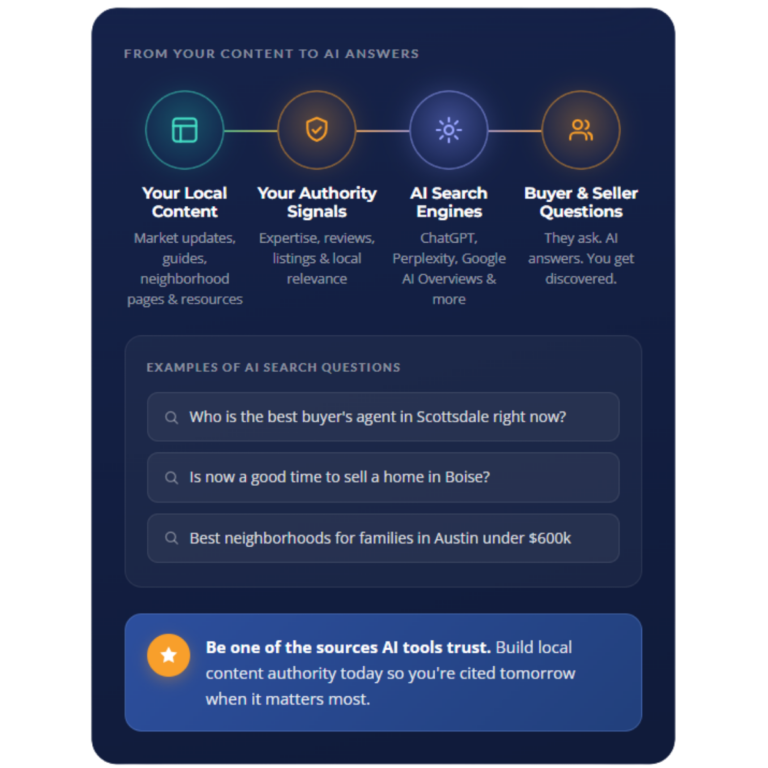
AI search is changing how buyers and sellers discover agents. ChatGPT, Perplexity and Google AI Overviews are now the first stop for real estate research. They cite 2 to 4 sources per answer.
• Sierra clients are being cited in AI answers right now
• Content authority takes months to build – first movers win
Ranking and recommendation are not the same thing, and the difference is bigger than it sounds. We wrote about why in Search Is Changing: Is Your Real Estate Business Ready for AI Recommendations?

Did You Know?
1 in 5 ChatGPT referral clicks converts to a lead. Is your site ready to catch it?
That traffic arrives already qualified. Someone asked a specific question, got an answer with your name in it and clicked through. It is the highest-intent traffic on the internet, and most real estate websites are not built to catch it. The visit ends without a capture, and nothing about it makes the next visit smarter.
The Five Pillars of AI Authority
Five factors determine whether AI search engines recommend a real estate company. They are not exotic. They are the fundamentals that have always separated a real digital asset from a brochure with a search bar. What changed is the payoff. In traditional search, doing this work moderately well earned a moderate ranking. In AI search, where only a handful of sources get named, doing it well is closer to a threshold condition.

Domain Authority & Ownership
Does the authority I build accrue to me?
Domain authority is cumulative, slow, and it belongs to whoever owns the domain. Content published on a portal profile, a franchise subdomain or a vendor-hosted search page builds authority for that domain, not yours. The most commonly missed piece is property search. IDX is typically your highest-engagement, longest-session, most-linked content. If it lives on a vendor domain, your strongest signal is building someone else’s asset.
What good looks like: You own the domain, and everything of value lives on it, including search.
Content Depth & Local Relevance
Is my content specific enough to be worth citing?
AI cites specific, locally authoritative sources. Forty generic posts about market trends compete against everyone. One genuine neighborhood guide (e.g., housing stock, price ranges, schools, commute realities, honest tradeoffs) competes against almost no one and answers a question a real buyer is actually asking. An MLS feed cannot produce that content. It requires someone who has walked the streets, which is your structural advantage over every national aggregator.
What good looks like: A real guide for every neighborhood you serve, plus market analysis carrying your interpretation rather than just the data.

Technical SEO Foundation
Can AI find, crawl, and trust my site at all?
Before your content can be evaluated, the site has to be crawled and parsed. That means fast mobile rendering, clean architecture, working internal links and real estate schema markup, like RealEstateListing, Place, LocalBusiness, FAQPage and Person. Schema is the clearest test of platform capability in this whole list, because you cannot write your way to structured data. Either your platform generates it or it does not.
What good looks like: Under three seconds on mobile, passing Core Web Vitals, schema applied by default rather than as a project.

AI-Ready Content Signals
Is my expertise easy to extract and attribute?
Two agents write equally good neighborhood guides. One is nine dense paragraphs of excellent prose. The other covers identical ground under clear headings with specific figures stated plainly. The second gets cited far more often, not because it is better written, but because an extractable claim under an accurate heading is a safe claim to attribute. AI will not cite what it cannot verify, so named authors and stated credentials matter as much as formatting. This pillar has the best effort-to-return ratio of the five, because it often requires no new content at all, just restructuring what you have.
What good looks like: Question-shaped headings, answers in the first sentence, tables for comparisons, dated figures and credentials stated explicitly rather than implied.

Lead Ownership & Compounding
Does the visibility I earn become an asset I keep?
A citation delivers a visitor. What happens in the next ninety seconds decides whether you built an asset or received a compliment. If they browse and leave unrecorded, the citation produced nothing durable. If they search on your domain, their behavior is captured and your follow-up responds to what they actually viewed The citation produced a lead, a data asset and a system that is smarter for the next visitor. Owned demand builds every cycle. Rented demand resets the month you stop paying.
What good looks like: Search on your own domain, behavior captured rather than just contact details, follow-up triggered by real activity and data you would keep if you switched providers.
The Five Pillars of AI Authority
Want the Full Framework?
What’s above is the framework in outline. The full breakdown goes pillar by pillar: what good looks like in practice, the signals AI actually evaluates and how to tell which one is costing you the most right now.

Where Does Your Site Stand Today?
Reading about the pillars is useful. Knowing which one is holding you back is more useful. The AI Authority Scorecard scores your site in about ten minutes and tells you where the gap is, and whether it is a quick fix or a structural limit of your current platform.

Know Where You Stand. Now Know What to Do.
The AI Authority Playbook is our complete point of view on what earns AI recommendations: every pillar
in depth, the compounding math behind owned demand and a 90-day roadmap.
Everything on AI search and real estate
The AI Authority Library
Start here

Not sure where you stand?
Score your website across the five pillars of AI authority in about ten minutes. See Your AI Authority Score

Want the whole framework?
Covers every pillar in depth,the math behind owned demand and a 90-day roadmap. Download the AI Authority Playbook

Already know something is off?
Find out what your platform will and won’t let you fix. Get the Platform Reality Check
The Framework
Start With How AI Search Actually Works

New to this?
The full argument for why AI search changes who gets called first, and what separates being ranked from being recommended. Is Your Business Ready?
Want the five pillars explained?
Each pillar in depth, with what good looks like and how to spot your own gaps. The Five Pillars of AI Authority

Not sure what actually counts as AI?
Most platforms call rules-based automation AI. Here’s the real difference, and the six categories that genuinely qualify. What “Real Estate AI Features” Means

Leads going cold before you reach them?
Why AI-referred leads arrive further along, at stranger hours, and expect an answer faster than most teams can give one. Speed-to-Lead in the AI Search Era
Go Deeper
Where Most AI Search Advice Gets It Wrong

Publishing more and seeing less?
Volume isn’t the lever. Why more AI-generated posts can leave you less discoverable rather than more. Why More Blogs Won’t Help

Ranking well but never cited?
Four things decide whether AI recommends a site, and design isn’t one of them. Which Websites AI Recommends

Lost in the terminology?
AEO, GEO, schema, IDX, domain authority. Plain definitions for every term on this page. Real estate technology glossary
Put It To Work
Checklists You Can Use Now

Not sure what to write about?
95 curated real estate keywords organized by category, with checkboxes to track what you’ve covered. Top 95 Real Estate Keywords Checklist

Want the technical basics covered?
Keyword research through Google Business Profile and tracking, a working checklist for the whole SEO foundation. The Real Estate SEO Checklist

Webinar Series: Win the AI Answer Game
Part One: How to Turn AI Into a Strategic Advisor for Your Real Estate Business
Available on demand
Most agents use AI to execute. This session is about using it to decide what to execute: building prompts that return recommendations rather than outputs, teaching AI your market and refining until the answer actually fits your business.
Part Two: How to Build Real Estate Content That AI Wants to Cite
Available on demand
The six ingredients that make content easy for AI to find, understand and recommend: leading with the answer, covering the questions AI is actually searching for, structuring for retrieval, connecting your content internally and going hyper-local enough to become the source.
TRUSTED BY TOP TEAMS AND BROKERAGES NATIONWIDE
Customer Success Stories

Case Study

Case Study

Case Study

Case Study


Frequently Asked Questions
Which of the five pillars should I fix first?
Whichever is weakest, because the pillars do not compensate for each other. Excellent local expertise on a site with no schema still struggles, and flawless structure with nothing worth citing has nothing to offer. The AI Authority Scorecard exists to tell you which one is your constraint, since it is rarely the one people guess.
Do I need to be technical to work on this?
Partly. Content Depth and AI-Ready Content Signals are mostly editorial — publishing what you know and structuring it so it can be extracted. Domain Authority and Lead Ownership are largely platform decisions. Technical SEO Foundation is the technical pillar, and much of it is determined by your platform rather than your effort, which is why it is worth knowing early whether yours can support it.
How long before this shows results?
Technical fixes and content restructuring can be done in about 30 days and often produce early gains. Meaningful content depth usually takes several months to build and begin earning citations. Compounding effects generally become significant over one to two years. Anyone promising faster is overselling.
Do I have to stop using portals?
No. Many successful Sierra clients buy demand while building it, then shift the mix as their owned engine matures. The problem is renting indefinitely while never building, because it leaves a business with no terminal asset — stop paying and the pipeline stops.
Can Sierra guarantee my site will be cited by AI?
No, and neither can anyone else. AI systems are proprietary and change frequently, so any vendor promising specific citation outcomes is overselling. What can be done is to build the inputs that consistently correlate with being cited — demonstrable expertise, domain authority, verifiable trust signals, sound structure, and current content.
What kind of team is this for?
All of them, but the constraint differs. A solo agent usually has genuine local expertise and no time to publish it. A growing team often publishes plenty but on a platform that cannot generate structured data. An enterprise brokerage typically has volume and authority but struggles with freshness across hundreds of pages. The pillars are the same; which one binds you is not.