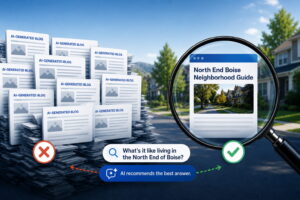
How AI Chooses Which Real Estate Websites to Recommend
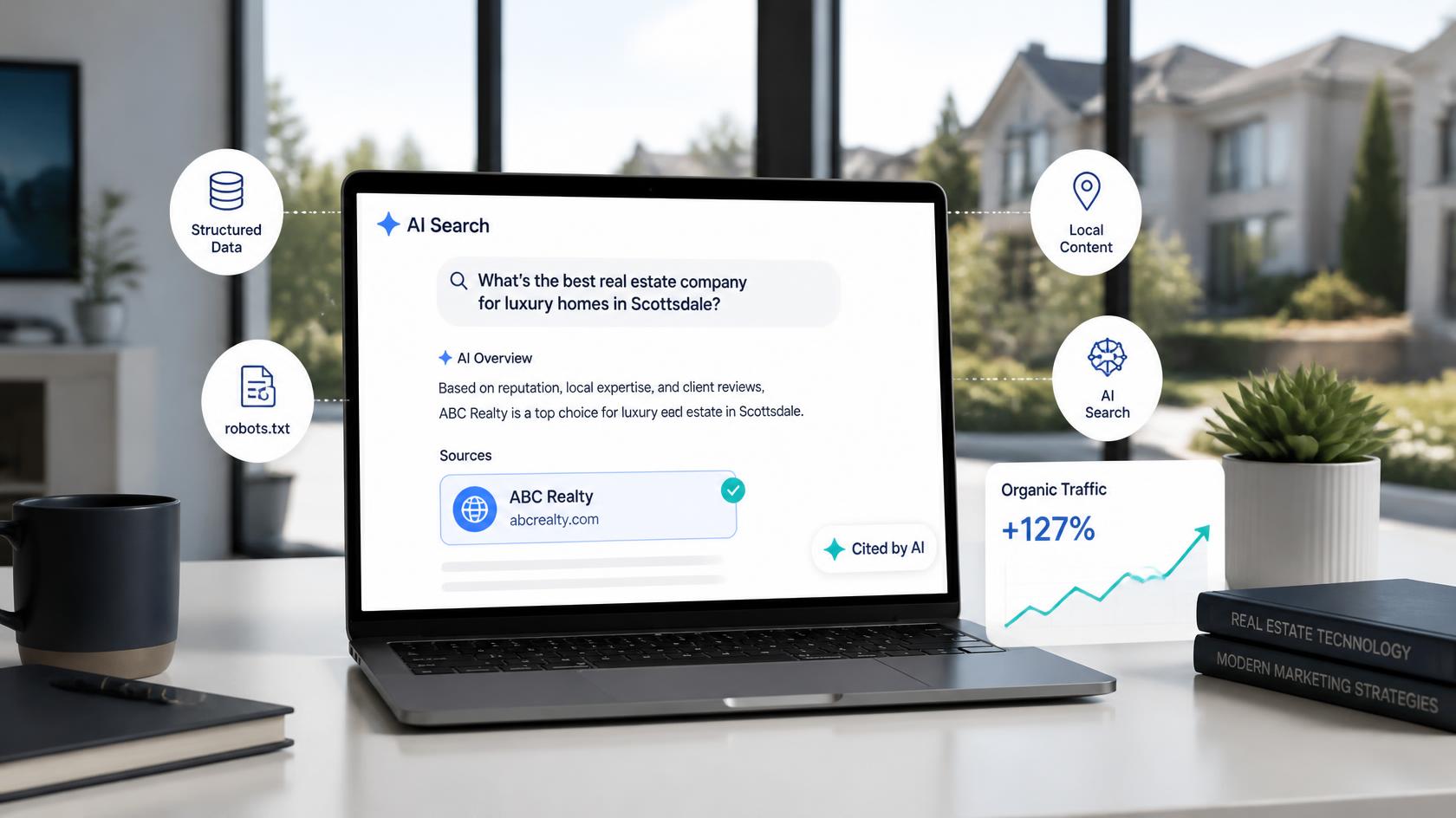
A buyer asks ChatGPT, Gemini, Claude or Perplexity a question about buying a home. One real estate professional gets named in the answer, often with a link and sometimes even a quote. The others don’t.
All of them may have modern websites. All of them may rank well in traditional search. So what made the difference?
Usually, it isn’t the design.
AI is most likely to recommend real estate websites that meet four criteria:
- AI can access the site’s content.
- AI can understand what the content means.
- The site contains original, specific information worth citing.
- The recommendation gives buyers a reason to click through and contact the agent.
Here’s what each of those looks like in practice.
#1. Can AI even get in?
Before AI can use your content, it has to be allowed onto your site in the first place.
That starts with a small file called robots.txt, which tells search engines and AI platforms what they’re allowed to access. Most real estate websites haven’t updated this file since before AI search became mainstream, and that’s often the first place we find a gap.
Sierra Interactive’s robots.txt is a good example of what this looks like. It gives the major AI platforms permission to crawl the site and use its pages to answer questions, while explicitly preventing them from using Sierra’s content to train their models.
That last distinction matters more than it might seem.
If an AI platform can train on your content, it can absorb your local expertise and answer future buyer questions without ever sending people back to your website or crediting you as the source. Allowing AI to search and cite your content while preventing model training helps ensure your expertise continues working for your business instead of becoming part of someone else’s product.
Giving AI permission to crawl your website isn’t just a technical best practice. It’s increasingly becoming a traffic opportunity.
Across Sierra Interactive websites, property listings are the largest source of AI referral traffic. Buyers are already discovering homes through AI-powered search experiences, and that trend is only accelerating. If your robots.txt file doesn’t clearly allow AI platforms to crawl and reference those listing pages, you’re making it harder for that traffic to find its way back to your website.
Bottom line: If AI can’t access your content, it can’t recommend it.
#2. Can AI understand what it finds?
Letting AI access your website is only the first hurdle. Once it’s on the page, it still has to understand what it’s looking at.
A person can glance at a property listing that says, “Stunning 4-bedroom colonial, $649,000, listed by Fox Homes Team,” and immediately recognize the asking price, the listing description and the listing agent. AI isn’t making those same assumptions. It needs clear signals that identify what each piece of information actually represents.
That’s where structured data, also known as schema markup, comes in. Structured data labels information behind the scenes so AI knows exactly what represents the listing price, property address, listing agent and other important details.
But understanding your content isn’t just about code. It’s also about how you present the information.
Imagine two agents publish neighborhood guides with equally valuable insights. One is written as nine long paragraphs. The other covers the same topics but uses descriptive headings, shorter sections and direct answers to common buyer questions.
Both guides may contain the same information. The difference is that the second one makes it much easier for AI to identify a clear answer and confidently reference it. AI isn’t looking for elegant prose. It’s looking for information that’s organized in a way it can understand without making assumptions.
The good news is that not all of this depends on your website platform.
Whether structured data is automatically generated is usually determined by your website provider. How your content is written and organized is completely within your control. In many cases, improving AI visibility isn’t about creating more content. It’s simply about restructuring the content you already have so both buyers and AI can find the answers more easily.
Bottom line: Structured data helps AI understand your content. Clear organization makes it easier for AI to quote it.
#3. Is there anything actually worth quoting?
Fast-loading pages and well-implemented structured data only get you so far. AI still needs something worth recommending.
That usually means original, locally focused content that answers real buyer questions with information buyers can’t easily find somewhere else.
Here’s the difference in practice.
One website has a comprehensive guide to horse properties in Denver. It includes original content, active listings, detailed information about the area and an FAQ that answers questions like, “Can I board horses on my property?”
A competing website has a search page with two generic paragraphs that could apply to almost any market.
When someone asks that exact question, AI has a complete, trustworthy answer it can confidently reference from the first website. The second website simply doesn’t give it enough information to work with.
Neighborhood content follows the same pattern.
A generic article about market trends could describe almost any city, so it competes with thousands of similar pages. A guide focused on one specific neighborhood, complete with housing styles, typical price ranges, nearby schools, commute times and honest tradeoffs, gives AI something far more valuable because it’s genuinely unique.
The same principle applies across your website. The more specific your expertise becomes, the fewer websites you’re competing against.
We’ve seen that difference reflected in our own data. Websites with deep, locally focused content average around 40 AI-driven leads per month. Thin content may generate an occasional referral, but it rarely earns consistent visibility because it doesn’t provide enough value for AI to confidently recommend it.
Bottom line: AI can’t recommend expertise that isn’t already on the page.
#4. Will buyers actually click?
Getting recommended by AI is an important first step, but it isn’t the finish line.
The recommendation still has to earn the click.
When AI includes your website as a source, buyers make the same split-second decision they would from a traditional Google search. Does this look credible? Does this page answer my question? Does this feel like someone who actually knows this market?
The websites that consistently turn AI recommendations into leads usually make those answers obvious. They have recognizable branding, clear page titles, current listings and content that demonstrates genuine local expertise from the moment someone lands on the page.
In other words, AI visibility creates the opportunity. Trust is what turns that opportunity into traffic, conversations and ultimately clients.
Bottom line: Being recommended gets you seen. Building trust gets you chosen.
Frequently Asked Questions
Does AI recommend real estate websites?
Yes. AI platforms like ChatGPT, Gemini, Claude and Perplexity regularly recommend real estate websites when answering questions about neighborhoods, home buying, market conditions and local real estate. Which websites they recommend depends on whether they can access, understand and trust the content.
How does AI choose which real estate websites to recommend?
AI looks for websites that are easy to crawl, clearly organized and filled with original content that directly answers buyers’ questions. Websites with structured data, detailed neighborhood pages and helpful FAQs are more likely to be cited than sites with thin or generic content.
What is Answer Engine Optimization (AEO)?
Answer Engine Optimization, or AEO, is the practice of creating content that AI platforms can easily understand, quote and recommend. While traditional SEO focuses on rankings in search engines, AEO focuses on becoming the source AI uses when answering questions.
Is AEO replacing SEO?
No. SEO and AEO work together. SEO helps people find your website through search engines, while AEO increases the chances that AI assistants will reference your content in their answers.
Does robots.txt affect AI visibility?
Yes. Your robots.txt file tells AI crawlers whether they can access your website. If important pages are blocked, AI may not be able to use them when generating answers or recommendations.
Does structured data help AI understand real estate websites?
Yes. Structured data labels information like listing prices, property addresses, agents and reviews so AI can understand what each piece of information represents. That makes it easier for AI to accurately cite your content.
What kind of content does AI recommend most often?
AI tends to recommend original, detailed content that answers specific buyer questions. Neighborhood guides, relocation resources, community pages, property-type guides and FAQ pages generally perform better than short, generic articles.
Why are neighborhood guides important for AI search?
Neighborhood guides provide the local expertise AI is looking for. Pages that explain housing styles, pricing, schools, amenities, commute times and local insights give AI useful information it can confidently reference when answering buyer questions.
Can AI recommend property listings?
Yes. Property listings are one of the most common sources of AI referral traffic. Listings that include complete property information, structured data and unique descriptions are more likely to appear in AI-generated answers.
How can real estate agents improve their AI visibility?
Real estate agents can improve AI visibility by allowing AI crawlers to access their websites, using structured data, publishing original local content and answering common buyer questions in a clear, easy-to-read format.
The takeaway
The websites AI recommends aren’t necessarily the newest or the most visually impressive. They’re the ones that make it easy for AI to access their content, understand what it finds and confidently cite the expertise on the page.
That isn’t something you accomplish with one technical update or one great article. It’s the result of building a website that consistently answers real buyer questions with clear, trustworthy and locally relevant information.
Traditional SEO is still essential for helping people discover your website. As AI search continues to grow, Answer Engine Optimization is becoming just as important because it determines whether your expertise is simply published online or actively recommended when buyers ask their next question.
Author

Related Posts

Real Estate CRM
Best Real Estate CRMs in 2026: An Honest...

Real Estate Business Planning