Speed-to-Lead in the AI Search Era: Why Automated Follow-Up Is Becoming the Default Real Estate Answer
Speed-to-lead is the time between a lead arriving and someone responding. It is the most studied metric in lead management and the most consistently ignored, because closing the gap requires a system rather than intention, and most teams have intention.
What has changed is where the leads come from. A growing share now arrive from AI assistants: someone asked ChatGPT or Perplexity who to call, got an answer naming two or three sources, and clicked through. Those leads behave differently from portal leads, and they make response time matter more, not less.
What is speed-to-lead in real estate?
Speed-to-lead measures elapsed time from inquiry to first meaningful contact. Meaningful is the operative word. An autoresponder confirming receipt is not contact. A text that answers the person’s actual question is.
The principle behind it is simple and well established: buyer intent decays quickly. Someone filling out a form at 9pm is comparing options, and whoever responds first frequently frames the entire conversation. Wait until morning and you are often responding to someone who has already spoken with two other agents.
The economics compound. A lead you paid to acquire and did not reach is a full loss, not a partial one. The acquisition cost is spent either way.
Why does speed-to-lead matter more for AI-referred leads?
This is where the familiar advice stops being sufficient. AI-referred leads differ from portal leads in three ways that all push the same direction.
They arrive further along
Someone who clicked through from an AI answer has already read a synthesis that named you as credible. They did not browse twelve profiles; they asked a question and got a short list. They arrive closer to a decision, and expectations scale with that. A person who has narrowed to three options is not waiting a day for one of them to call back.
They arrive at unpredictable hours
AI assistants are used heavily outside business hours, when research is what a person can do alone. That produces high-intent inquiries at 11pm on a Sunday. Any response system depending on someone being at a desk will miss a meaningful share of them entirely.
They convert at higher rates, which raises the cost of missing them
Roughly 1 in 5 ChatGPT referral clicks becomes a lead. That reflects how qualified the traffic is. The visitor arrived because a specific question got a specific answer. It also means each missed one costs more than a missed portal lead, because the pool is smaller and better.
What is real estate task automation?
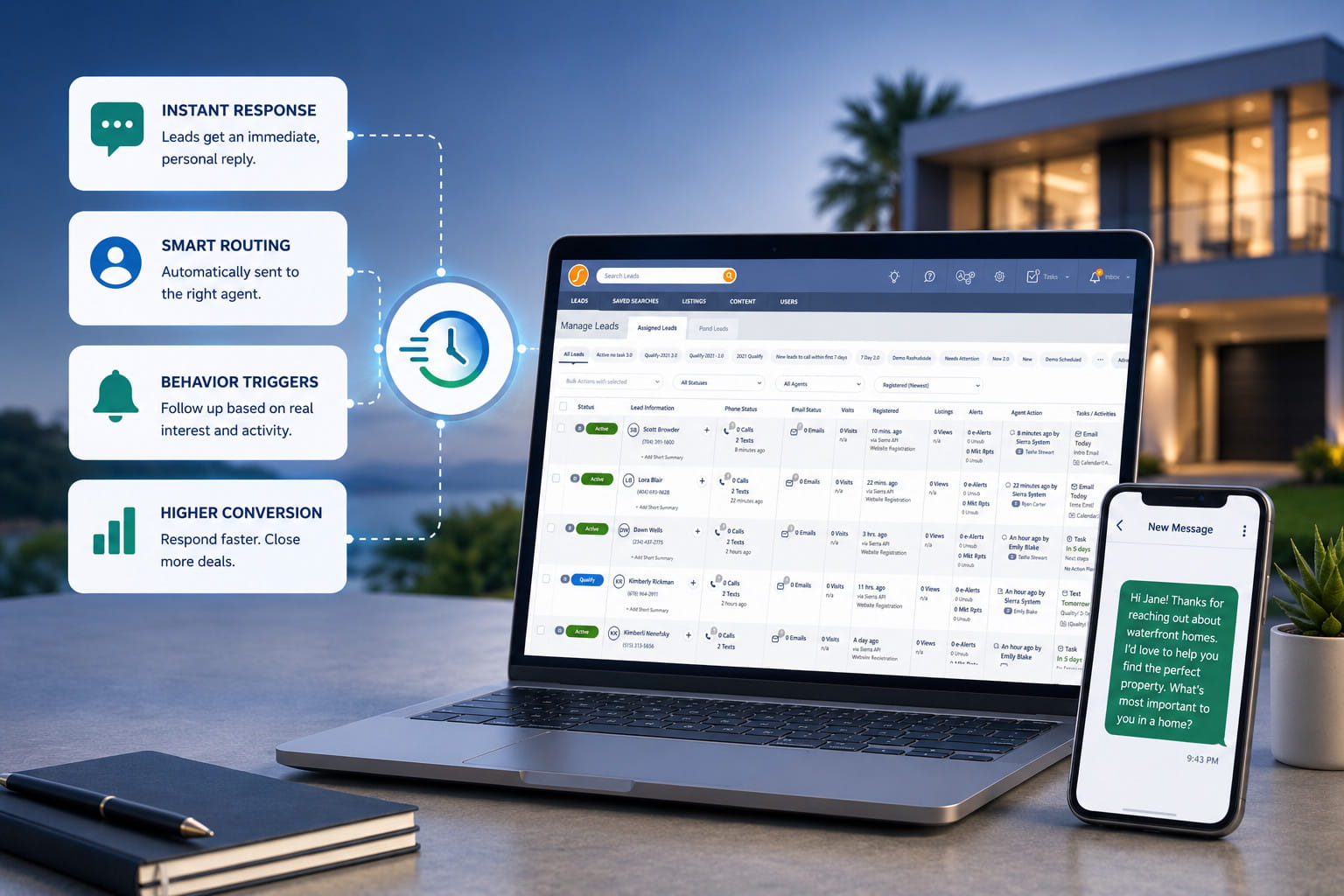
Real estate task automation is software handling the repetitive, time-sensitive work of lead management, including responding, routing, alerting, scheduling and following up, without someone initiating each action.
It is worth being precise about what it does and does not replace. Automation handles timing and volume: reaching someone within a minute at 11pm, sending the listing alert that matches a saved search, moving a lead to the right agent, resurfacing someone who went quiet for three weeks. It does not replace judgment, negotiation, or the relationship. Those were never the bottleneck.
The bottleneck is that the work requiring immediate response arrives when nobody is available, and the work requiring persistence gets dropped once the pipeline gets busy. Both are structural, and both are solvable.
Which tasks should real estate teams automate first?
| Task | Why automate it | What good looks like |
| First response | Intent decays fastest in the first minutes | Immediate text or email that answers the actual question |
| Lead routing | Manual assignment adds delay and gets missed | Routing by your rules, instantly, including after hours |
| Listing alerts | Matching is repetitive and time-sensitive | Triggered by saved search behavior, not a weekly digest |
| Behavioral follow-up | Live intent is invisible without triggers | Fires on return visits and repeat listing views |
| Lead scoring | Prioritizing by hand does not scale | Ranked by behavior, updated continuously |
| Re-engagement | Quiet leads get dropped when the pipeline is busy | Automatic resurfacing when someone returns |
First response and lead routing are where most teams should start, because they are the highest-leverage and the least dependent on anything else being in place.
How fast is fast enough?
Under five minutes for a first response is the widely used benchmark, and for AI-referred leads arriving outside business hours, functionally that means immediate, because there is no one to respond in five minutes at 11pm.
The more useful reframe is that speed-to-lead is not really a target to hit. It is a property of your system. A team responding in four minutes on Tuesday afternoon and eleven hours on Saturday night does not have a four-minute response time. It has an inconsistent one, and the inconsistency is where leads are lost.
Why does automated follow-up depend on your website and CRM being connected?
Behavioral automation needs behavior, and behavior is generated on the website.
If your website and CRM are separate systems joined by an integration, what typically crosses the boundary is a lead record: name, email, source, timestamp. What usually does not cross is the detail: which neighborhoods they searched, which listings they returned to, what price band they filtered to on the third visit. So the CRM knows a lead exists. It cannot trigger on behavior it never received.
That is why so much “automated follow-up” in the category is really scheduled follow-up. Day one, day three, day seven, regardless of what the person did. It runs automatically, which is not the same as responding to anything.
There is a related issue worth checking. If your property search runs on a vendor’s domain rather than your own, the richest behavioral signal you generate is captured somewhere you do not control, and it is generally not coming back.
How to build follow-up that runs itself
1. Measure your current response time honestly, including nights and weekends. Most teams measure only business hours, which is where the number looks best.
2. Automate first response before anything else. An immediate, relevant reply at any hour is the single highest-return change available.
3. Set routing rules that work when nobody is watching, including fallbacks when the first assignee does not respond.
4. Connect behavior to triggers. Return visits, repeat listing views, and new saved searches should each start something.
5. Add re-engagement for quiet leads, so the pipeline resurfaces them rather than depending on someone remembering.
6. Review what actually fired monthly. Automation drifts, and a broken trigger is silent.
The connection to AI search visibility
These two subjects are usually treated separately and they should not be. AI search visibility determines whether high-intent leads reach you. Task automation determines whether you convert them once they do.
They also share a foundation, which is the practical point. Both require owning your domain, capturing behavior rather than just contact details, and running a connected system instead of a stitched one. The decisions that make you discoverable are largely the decisions that make your follow-up work.
See What a Website Built for AI Authority Looks Like
Frequently Asked Questions
What is a good speed-to-lead time in real estate?
Under five minutes is the widely used benchmark for first response. What matters more than the average is consistency. A team averaging four minutes during business hours and eleven hours overnight does not have a four-minute response time, and the overnight gap is where high-intent leads are lost.
What is real estate task automation?
Real estate task automation is software handling repetitive, time-sensitive lead management work (first response, routing, listing alerts, behavioral follow-up, lead scoring, and re-engagement) without someone initiating each action. It addresses timing and volume, not judgment or negotiation.
Which real estate tasks should be automated first?
First response and lead routing. Both are high-leverage, both fail most often outside business hours, and neither depends on anything else being in place. Behavioral triggers and lead scoring add more value but require connected behavioral data to work properly.
Is automated follow-up the same as a drip campaign?
No. A drip campaign sends on a schedule regardless of what the recipient does. Behavioral follow-up fires in response to actual activity, such as a return visit, a repeat listing view or a new saved search. Both run automatically, but only one responds to intent.
Why do AI-referred leads need faster follow-up?
They arrive further along, having already read an answer that named you among two to four sources, so their expectations are higher. They also arrive at unpredictable hours, since AI research happens outside business hours. And they convert at higher rates, which makes each missed one more costly than a missed portal lead.
Can follow-up automation work if my website and CRM are separate?
Partly. Most integrations pass lead records but not detailed behavior, so scheduled follow-up works while behavioral triggering largely does not. The CRM cannot fire on activity it never received. This is why much of what gets called automated follow-up is really scheduled follow-up.
Author

Related Posts

Real Estate Business Planning