Why Publishing More AI-Generated Blogs Won’t Make You More Discoverable
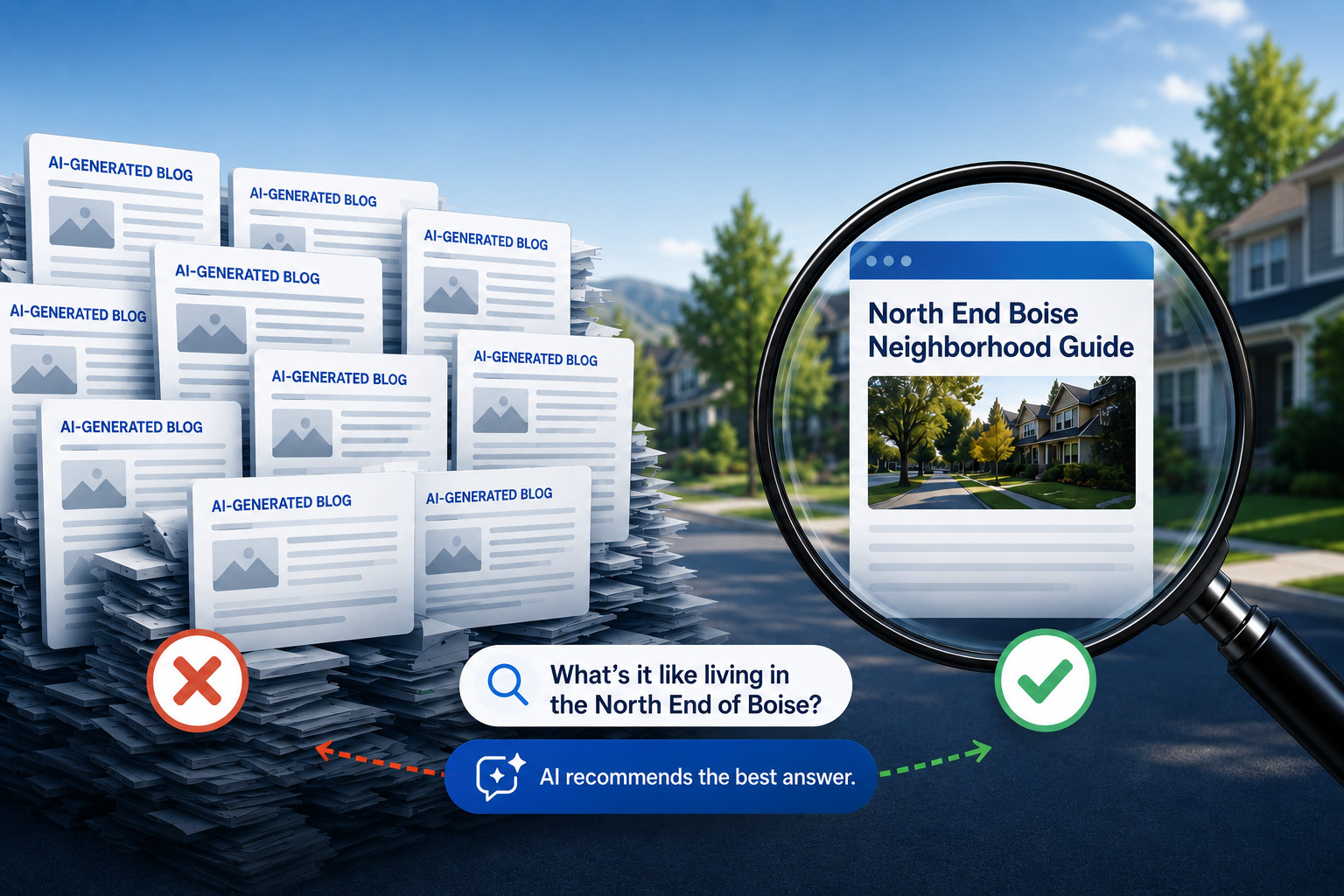
Publishing more content will not make AI more likely to recommend you. In many cases, it makes things worse.
This is a counterintuitive claim, so it is worth being precise about it. The problem is not that AI helped write the content. The problem is volume as a strategy, and AI has made volume so cheap that it has become the default response to the AI search shift, at exactly the moment when volume stopped working.
Why doesn’t more content improve AI visibility?
Because AI does not choose sources by counting pages, it chooses the source that answered the specific question best.
When someone asks an assistant “what’s it like living in the North End of Boise?”, it needs a source that has actually addressed that. Forty posts about Boise real estate trends do not answer it. One thorough North End guide answers it completely, and there may be only two or three genuine sources competing for that citation.
That is the whole mechanic. Broad pages compete in the most crowded part of the field for queries where buyer intent is lowest. Specific pages compete against almost nothing for queries where intent is highest. Adding thirty more broad pages adds thirty more entries to the crowded end.
Can publishing more content actively hurt you?
Duplicated content is a negative signal, not a neutral one
Templated market reports and syndicated descriptions appear on hundreds of agent sites simultaneously. When an evaluation layer encounters the same paragraph across four hundred domains, it has no basis for preferring your copy, and the duplication itself suggests the source is not original. AI-generated content trained on the same prompts produces the same effect at speed, because prompts like “write a blog post about the Boise real estate market” return substantially similar output for everyone using them.
Thin pages dilute the signal from your strong ones
A site with four excellent neighborhood guides and eighty filler posts is harder to evaluate than a site with four guides. The strong pages are still there, but the domain now reads as a content mill rather than a local authority, and internal linking gets diluted across pages that were never worth linking to.
It consumes the capacity you needed for depth
This is the least discussed and most expensive cost. The time and budget spent producing eighty thin posts was the time and budget that could have produced eight real guides. Volume feels productive because output is measurable. Depth is slower and harder to point at in a monthly report.
What can AI-generated content not do?
It cannot know your market, and that is precisely what earns citations.
A language model generating content about the North End of Boise is working from what has already been published about the North End of Boise. It can produce something fluent and broadly accurate. What it cannot produce is the thing that makes a source worth citing. First-hand knowledge that does not exist anywhere else yet.
Which streets flood. Which blocks are quiet on weekends and which are not. Why the 1920s houses on one side of the park sell faster than the comparable stock two streets over. What a buyer relocating from out of state consistently gets wrong about the commute. None of that is in the training data, because the only person who knows it is someone who has worked the market. That is your structural advantage over every national aggregator, and it is the one thing that cannot be replicated at volume by anyone, including you, with a better prompt.
AI can help you publish what you know faster. It cannot help you know more.
So should real estate agents use AI to write content at all?
Yes, for drafting and restructuring, not for sourcing.
The distinction is what the AI is being asked to supply. If you supply the local knowledge and the tool supplies the first draft, structure and cleanup, that is a genuine acceleration of work only you could do. If the tool is supplying the substance, you are publishing a remix of what is already indexed and there is no reason for an assistant to cite your version of it.
Two uses hold up well in practice. Drafting, where you outline what you know about a neighborhood and the tool produces a first version in your voice for you to correct and add to. And restructuring, where you take pages you have already written and reshape them into question-shaped headings, answer-first paragraphs and FAQ sections. Mechanical work that is genuinely faster with help.
Sierra Interactive clients use DraftAI for exactly this, or hand production to the Content Writing Service where the bottleneck is time rather than knowledge. Either way, the local expertise has to come from a person.
What should you publish instead?
| Instead of | Publish | Why it works |
| Monthly market trend posts | One market analysis with your interpretation | Data is commodity. Your read on it is not. |
| Generic city landing pages | A real guide per neighborhood you serve | Specific queries have almost no competition |
| “Top 10 tips” listicles | Direct answers to questions you get on the phone | Matches how buyers actually ask |
| Volume across many topics | Depth on the few you genuinely know | Depth is what cannot be replicated |
| Syndicated listing descriptions | Original descriptions with local context | Duplication is a negative signal |
A practical cadence for most teams: one substantial piece monthly (e.g., full neighborhood guide or a real market analysis), plus two or three shorter pieces answering specific questions. Over a year, that is roughly forty pieces, nearly all of them citable. The same forty pieces produced as broad posts would be worth close to nothing.
How do you know if your content is working?
Stop counting posts and start checking citations.
Ask an assistant the questions your buyers ask about your market and see who gets named. Look at which of your pages actually receive organic and AI-referred traffic. In most cases, it is a small number of specific pages carrying the site, which tells you what to build more of. And watch whether your cost per lead is trending down over time, because a content library that compounds should make each additional lead cheaper, not the same.
If you are publishing consistently and none of those three signals is moving, the problem is almost never that you need more posts.
Download the AI Authority Playbook →
FAQ
Does AI-generated content hurt SEO?
Not inherently. What hurts is content that is generic, duplicated, or thin regardless of how it was produced. AI makes it much easier to produce content with those characteristics at scale, which is why the two get conflated. AI-assisted content built on genuine first-hand knowledge performs like any other good content.
Does publishing more blog posts improve AI visibility?
No. AI selects sources by relevance and specificity to a question, not by counting pages on a domain. One thorough neighborhood guide typically outperforms forty broad market posts, because it answers a specific question almost nothing else answers.
How much content should a real estate team publish?
Depth matters more than cadence, but a workable rhythm for most teams is one substantial piece monthly (e.g., a full neighborhood guide or a market analysis with your own interpretation), plus two or three shorter pieces answering specific buyer questions. Roughly forty pieces a year, nearly all of them worth citing.
Can AI write neighborhood guides?
It can draft one from information already published about that neighborhood, which produces something fluent but not distinctive. What it cannot supply is first-hand local knowledge that is not yet online, and that is exactly what makes a guide worth citing. The workable approach is to supply the knowledge yourself and use AI to accelerate the drafting.
Why does duplicate content matter for AI search?
When the same text appears across hundreds of domains, an assistant has no basis for preferring one source over another and the duplication itself signals that the content is not original. Syndicated listing descriptions and templated market reports both create this problem, and generic AI output produced from common prompts creates it faster.
What is the difference between thin content and depth?
Thin content could describe almost any market – it competes against thousands of near-identical pages. Depth is specific enough that very little else answers the same question: housing stock, real price ranges, schools, commute realities and honest tradeoffs for one particular neighborhood. The more specific the content, the fewer sources you are competing against.
The takeaway
The instinct to respond to AI search by publishing more is understandable, and it is the wrong lever. Assistants cite two to four sources per answer, and they choose them on specificity and authority rather than volume.
Which means the winning move is uncomfortable for most content programs: publish less, know more and structure what you know so it can be extracted. AI can make that faster. It cannot do it for you.
Author

Back to Blog