Search Is Changing: Is Your Real Estate Business Ready for AI Recommendations?

A buyer in your market opens ChatGPT and types: “Who’s the best listing agent in Boise?”
They don’t get ten blue links. They get an answer: two or three names, a sentence on why each one and a short list of cited sources. Then they act on it.
That interaction is now common enough to matter. ChatGPT, Perplexity and Google AI Overviews have become a first stop for real estate research, and they cite two to four sources per answer. For twenty years, being found meant ranking. It increasingly means being recommended, and those are not the same problem.
What is changing in how buyers find real estate agents?
The mechanics of discovery are shifting from a list to an answer.
A search results page is a menu. It presents options and leaves the comparing to the person – ten links, a few ads and the assumption that they will open several and decide. That model rewarded presence. Being on page one meant being in the running, even at position seven.
An AI assistant does the comparing for them. It reads across sources, synthesizes and returns a recommendation with a handful of citations. The buyer is not handed ten options to evaluate. They are handed two or three, already framed as credible.
This is not a prediction about where things are heading. It is a description of how a meaningful and growing share of real estate research already happens, particularly for the high-intent questions that precede a phone call.
What is the difference between being ranked and being recommended?
Ranking is a position in a list. Recommendation is a citation inside an answer. The difference is how much room each one leaves you.
Rank seventh on Google and you lose most of the clicks, but you exist. Someone scrolling can still find you, and a compelling title can still earn the visit. The page is forgiving in a way that matters.
An AI answer names two to four sources. There is no eleventh slot, no second page, no scrolling past the fold. If you are not cited, you are not in that conversation at all, and the buyer never learns you were an option worth considering. The distribution of attention compressed from a long tail into a very short one. The traffic that does come through behaves differently, too. Someone who clicks a cited source has already read a synthesis that named you as credible. They are not starting a comparison; they are partway through one, with you inside the shortlist. Roughly one in five ChatGPT referral clicks converts to a lead, which is a rate that reflects how pre-qualified that visitor is by the time they arrive.
How does AI decide which real estate companies to recommend?
The systems are proprietary and they change often, so nobody outside those companies can hand you a formula. But the mechanics are less opaque than they look, and three things happen in some form across every major platform.
First, retrieval
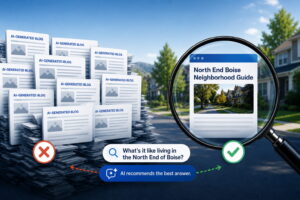
The system finds content relevant to the question, and this stage rewards specificity above nearly everything else. A page titled “Boise Real Estate” competes with tens of thousands of near-identical pages, all of them generic. A page titled “North End Boise Neighborhood Guide: Schools, Home Prices and What It’s Like to Live There” competes with very few, and it matches the actual shape of what someone asked. This is the first place most real estate websites lose. Not because the content is bad, but because it is broad. Broad pages compete in the most crowded part of the field for queries where intent is lowest.
Second, evaluation
Retrieved sources get assessed for authority and reliability. Domain history, publishing consistency, inbound links and whether the content demonstrates genuine expertise or reads as filler assembled to fill a slot.
This is where a great deal of real estate content quietly fails, and the reason is structural rather than editorial. Syndicated listing descriptions and templated market reports appear on hundreds of domains at once. When an evaluation layer encounters the same paragraph across four hundred sites, it has no basis for preferring your copy of it. Duplicated content does not just fail to help, it actively signals that a source is not original.
Third, synthesis and citation
The system composes an answer and attributes it. Content that states a claim plainly, supports it with a specific figure and puts it under an accurate heading is easy to lift and safe to credit. Content that buries the same insight in the fourth sentence of a long paragraph often loses the citation to a source that made extraction easier, even when the buried insight was better.
It also has to be attributable. An assistant citing a claim is putting its own accuracy behind it, so a page with a named author and stated credentials is a safer citation than an anonymous one making the identical point.
Read those three stages together and the conclusion is uncomfortable but clarifying. Being right is not sufficient. Being right, in an extractable form, on a domain that has demonstrated authority. That is what earns a citation.
What determines whether AI recommends your real estate business?
Sierra Interactive organizes the answer into five pillars of AI authority. They fall out of the three stages above rather than sitting alongside them: retrieval rewards depth and specificity, evaluation rewards owned authority and originality, synthesis rewards extractable structure and verifiable expertise.
Underneath all three sits a technical requirement basic enough to skip. And after the citation is earned, there is the question of whether it becomes anything durable.
Domain Authority & Ownership
Authority is cumulative, slow and it belongs to whoever owns the domain. Content published on a portal profile, a franchise subdomain or a vendor-hosted search page builds that domain’s authority rather than yours. The most commonly missed piece is property search. IDX is typically the highest-engagement, longest-session, most-linked content on a real estate site and when it lives on a vendor domain, the strongest signal you generate accrues to someone else.
Content Depth & Local Relevance
AI cites specific, locally authoritative sources. Forty generic posts about market trends compete against everyone. One genuine neighborhood guide (e.g., housing stock, price ranges, schools, commute realities, honest tradeoffs) competes against almost no one. An MLS feed cannot produce that. It requires someone who has walked the streets, which is the one advantage no national aggregator can replicate.
Technical SEO Foundation
Before content can be evaluated, the site has to be crawled and parsed. Fast mobile rendering, clean architecture, working internal links and real estate schema markup. Schema is the clearest test of platform capability on this list, because you cannot write your way to structured data. Either the platform generates it or it does not.
AI-Ready Content Signals
Two agents write equally good guides. One is nine dense paragraphs; the other covers identical ground under clear headings with dated figures stated plainly and a byline that establishes who is speaking. The second gets cited far more often. This pillar has the best effort-to-return ratio of the five, because it frequently requires no new content at all, only restructuring what already exists.
Lead Ownership & Compounding
A citation delivers a visitor. What happens next decides whether you built an asset or received a compliment. If they browse and leave unrecorded, the citation produced nothing durable. If they search on your domain, their behavior is captured, and follow-up responds to what they actually viewed, then the citation produced a lead, a data asset and a system slightly smarter for the next visitor. Owned demand compounds. Rented demand resets the month you stop paying.
Do AI features and automation affect whether you get recommended?
Indirectly, and the connection is worth drawing because it is usually missed.
The five pillars determine whether high-intent visitors reach you. What happens after they arrive determines whether that visibility becomes a business. Both depend on the same underlying conditions: owning your domain, capturing behavior rather than just contact details and running a connected system instead of a stitched one.
That last condition is the one that quietly breaks things. If the website and CRM are separate systems joined by an integration, what typically crosses the boundary is a lead record, including name, email and source. What does not cross is the behavioral detail: which neighborhoods they searched, which listings they returned to, what price band they filtered to on the third visit. So the follow-up cannot respond to behavior it never received, and features that depend on behavioral signal run on much thinner inputs than their marketing suggests.
This matters for AI search specifically because AI-referred visitors arrive at unpredictable hours, further along in their thinking and with less patience than portal leads. The system that catches them has to work without anyone watching it.
Why does this matter now rather than later?
Every discovery shift in real estate has followed the same shape. An early window where effort produces outsized returns, then a long stretch where the positions established in that window prove difficult to dislodge.
Agents who invested in SEO while their competitors bought newspaper ads built organic engines still producing a decade later. Agents who took mobile seriously captured years of buyers who never opened a desktop browser. In both cases, the advantage did not come from being better. It came from being earlier, and then from the fact that authority accumulates and compounds.
AI search is that window now, and it is narrower than the last one. The industry has an estimated 18-month window before citation patterns settle. Content authority takes months to build, which means the businesses holding cited positions when patterns firm up will be hard to displace.
Sierra clients are being cited in AI answers right now. The practical question is not whether this work is worth doing. It is whether you begin it while the window is still open.
Real estate AI traffic growth and the 18-month window are Sierra Interactive market observations presented as context and trajectory, not certainties.
Where should you start?
With an honest baseline, because the five pillars are rarely broken evenly.
Some businesses have real local expertise that has simply never been published. Others publish constantly on a platform that cannot generate schema. Some have both and lose every visitor at the point of capture. From the outside, these look like the same problem (“we’re not showing up”), and they require entirely different responses. Guessing wrong costs a quarter.
The AI Authority Scorecard scores your site across all five pillars in about ten minutes. You finish with a number, a tier, your weakest pillar and a specific list of what to address first, including whether each gap is a quick fix or a structural limit of your current platform. It is free, and there is no form.
Frequently Asked Questions
Can AI recommend a real estate agent?
Yes, and it already does. Ask ChatGPT or Perplexity who the best listing agent in a given city is and you will get named recommendations with cited sources. Because assistants name only two to four sources per answer, the practical question is not whether AI recommends agents but whether it recommends you.
What is AI search optimization for real estate?
It is the practice of making your website discoverable, verifiable and citable by AI assistants rather than only rankable by search engines. It shares a technical foundation with SEO but weights content depth, structured data, extractable formatting and verifiable expertise more heavily. It is sometimes referred to as AEO or GEO, which stands for answer engine or generative engine optimization.
Is AI search optimization different from SEO?
They overlap substantially but optimize for different outcomes. SEO optimizes for a position among ten links, where page one still earns traffic. AI search optimizes for being one of the two to four sources named inside a generated answer. Strong SEO is a solid foundation and does not automatically make you citable.
How long does it take to build AI authority?
Technical fixes and content restructuring can be completed in roughly 30 days and often produce early gains. Meaningful content depth usually takes several months to build and begin earning citations. Compounding effects generally become significant over one to two years. Anyone promising faster than that is overselling.
Can a platform guarantee AI recommendations?
No. AI systems are proprietary and change frequently, so any vendor promising specific citation outcomes is overselling. What can be done is to build the inputs that consistently correlate with being cited: an owned domain, genuine content depth, a sound technical foundation, extractable structure and a conversion loop that keeps what you earn.
Author

Related Posts

Real Estate Business Planning