The Five Pillars of AI Authority for Real Estate Companies
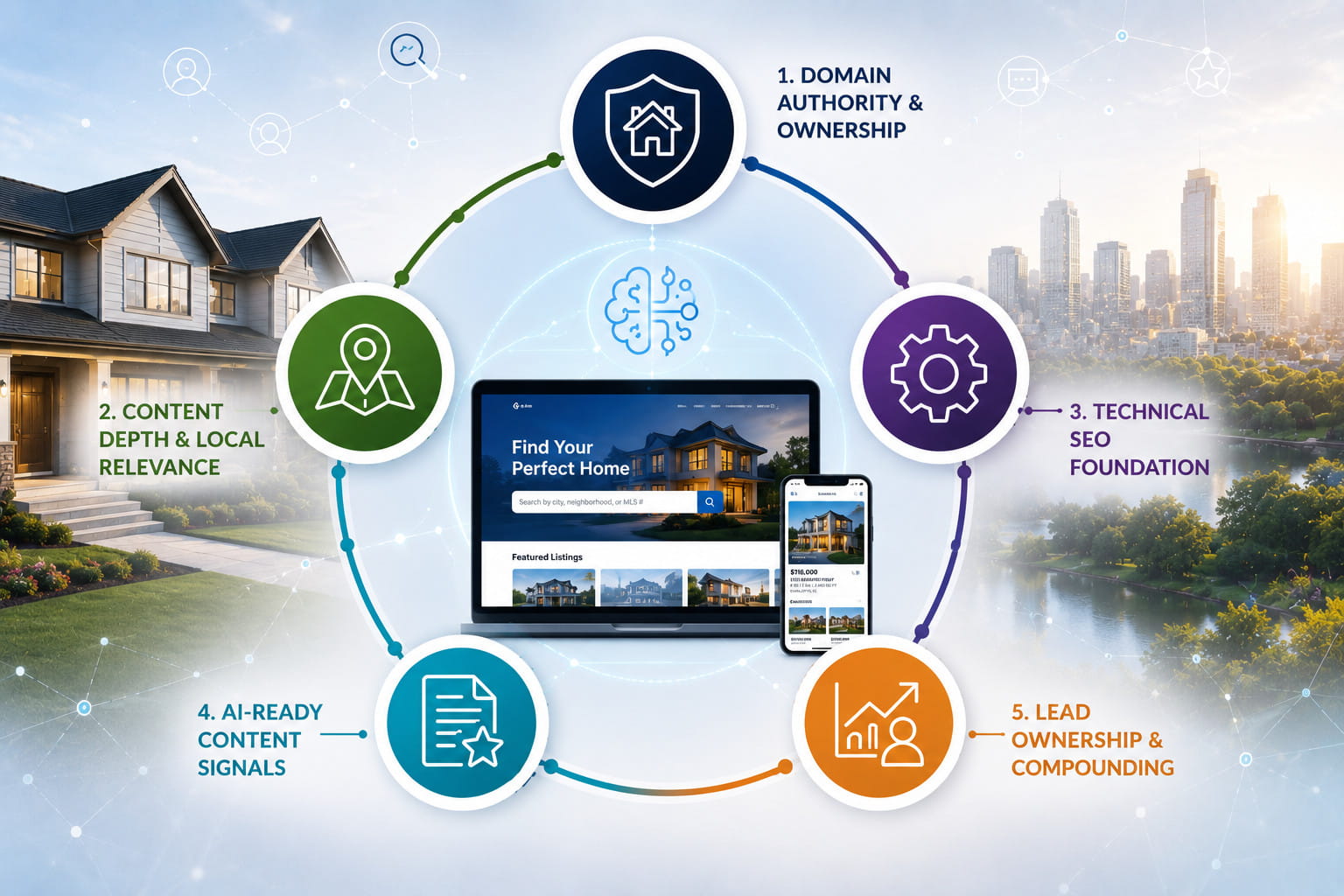
AI authority is the combination of signals that determines whether an AI assistant will cite your real estate website when answering a buyer’s question. It rests on five pillars: domain authority and ownership, content depth and local relevance, technical SEO foundation, AI-ready content signals and lead ownership and compounding.
None of the five are exotic. They are the fundamentals that have always separated a real digital asset from a brochure with a search bar. What changed is the payoff structure. In traditional search, doing this work moderately well earned a moderately good ranking. In AI search, where assistants cite only two to four sources per answer, doing it well is closer to a threshold condition. You are either in the answer or absent from it.
Here is what each pillar covers, what AI is actually evaluating, and how to tell which one is currently costing you the most.
What are the five pillars of AI authority?
| Pillar | What it covers | The question it answers |
| 1. Domain Authority & Ownership | Where your authority accumulates | Does the authority I build accrue to me? |
| 2. Content Depth & Local Relevance | Whether your content is worth citing | Is my content specific enough to be worth citing? |
| 3. Technical SEO Foundation | Whether AI can access and parse your site | Can AI find, crawl and trust my site at all? |
| 4. AI-Ready Content Signals | Whether your expertise can be extracted | Is my expertise easy to extract and attribute? |
| 5. Lead Ownership & Compounding | Whether visibility becomes a durable asset | Does the visibility I earn become an asset I keep? |
The pillars are not independent, and they are not equally broken for everyone. A business with genuine local expertise that has never been published has a very different problem from one publishing constantly on a platform that cannot generate structured data. Both present the same way from the outside (“we’re not showing up”), and they require entirely different responses.

Pillar 1: Does the authority you build accrue to you?
Domain authority is cumulative, slow and it belongs to whoever owns the domain. That is the whole of this pillar, and it is the one that determines whether the other four compound or evaporate.
AI assistants weigh source credibility heavily, and credibility is measured at the domain level. An assistant deciding whether to trust a source on the Charlotte market is implicitly asking whether that domain has demonstrated sustained expertise there. Four years of neighborhood guides and market analysis answers that convincingly. A profile page on a portal does not, because the portal’s authority belongs to the portal.
Where real estate authority leaks
Four patterns account for most of it, and all four are common enough to be nearly invisible.
Portal profiles as primary presence. Years of reviews, listings and traffic accumulate, and every signal strengthens the portal’s domain rather than yours. This is not an argument against using portals, which many agents do productively. It is an argument against portals being the only place your authority lives.
Third-party property search on a separate domain. Your site is yoursite.com but search runs at search.vendor.com. Property search is typically the highest-engagement, longest-session, most-linked content on a real estate website and hosting it off-domain means your single strongest engagement signal flows to a vendor. Across Sierra Interactive websites, property listings are the largest source of AI referral traffic, which makes where they live a consequential decision.
Franchise and brokerage microsites. Content published on a corporate domain builds the brand’s authority, and it generally cannot move with you. Years of compounding work resets at the moment you have least capacity to rebuild it.
Syndicated and templated content. Market reports distributed identically across hundreds of agent sites carry no authority signal for any of them. When an evaluation layer meets the same paragraph on four hundred domains, it has no basis for preferring yours.
What good looks like
You own the domain outright, your property search runs on it, your content is original to it, and nothing of value would be lost if you changed brokerages tomorrow.

Pillar 2: Is your content specific enough to be worth citing?
AI cites specific, locally authoritative sources, which means depth matters more than volume, and the advice most agents receive gets this backwards.
Consider what an assistant does with “what’s it like living in the North End of Boise?” It needs a source that has actually addressed that. Forty generic posts about Boise real estate trends do not answer it. One thorough North End guide (e.g., architecture, walkability, schools, price ranges, who the neighborhood suits and who it does not) answers it completely, and there may be only two or three genuine sources competing for that citation.
Forty generic posts compete against everyone. One genuinely specific page competes against almost no one, and it matches a question a real buyer is actually asking.
The content types that earn citations
Neighborhood and community guides. The highest-value content most real estate sites lack. Not a paragraph and a listing grid, but a real guide covering housing stock, price ranges, schools, commute realities, local character and honest tradeoffs. MLS feeds cannot produce this. It requires someone who has walked the streets, which is your structural advantage over every national aggregator.
Local market analysis with your interpretation. Data alone is a commodity. Everyone has the same MLS numbers. The citable layer is what the numbers mean, why they moved and how you would advise someone given the conditions.
Direct answers to real buyer and seller questions. Every question you answer repeatedly on the phone is a page you should own. Closing costs in your market. Buyer’s or seller’s market right now. Sell before you buy.
Comparisons and decision frameworks. AI systems favor comparison content heavily, because comparison is what users are asking for. Neighborhood versus neighborhood. Buying versus renting locally. New construction versus resale.
What good looks like
Every neighborhood you serve has a real guide. Your market commentary says something only you could say, and the questions you answer on the phone are answered on your site.
Pillar 3: Can AI find, crawl and trust your site at all?
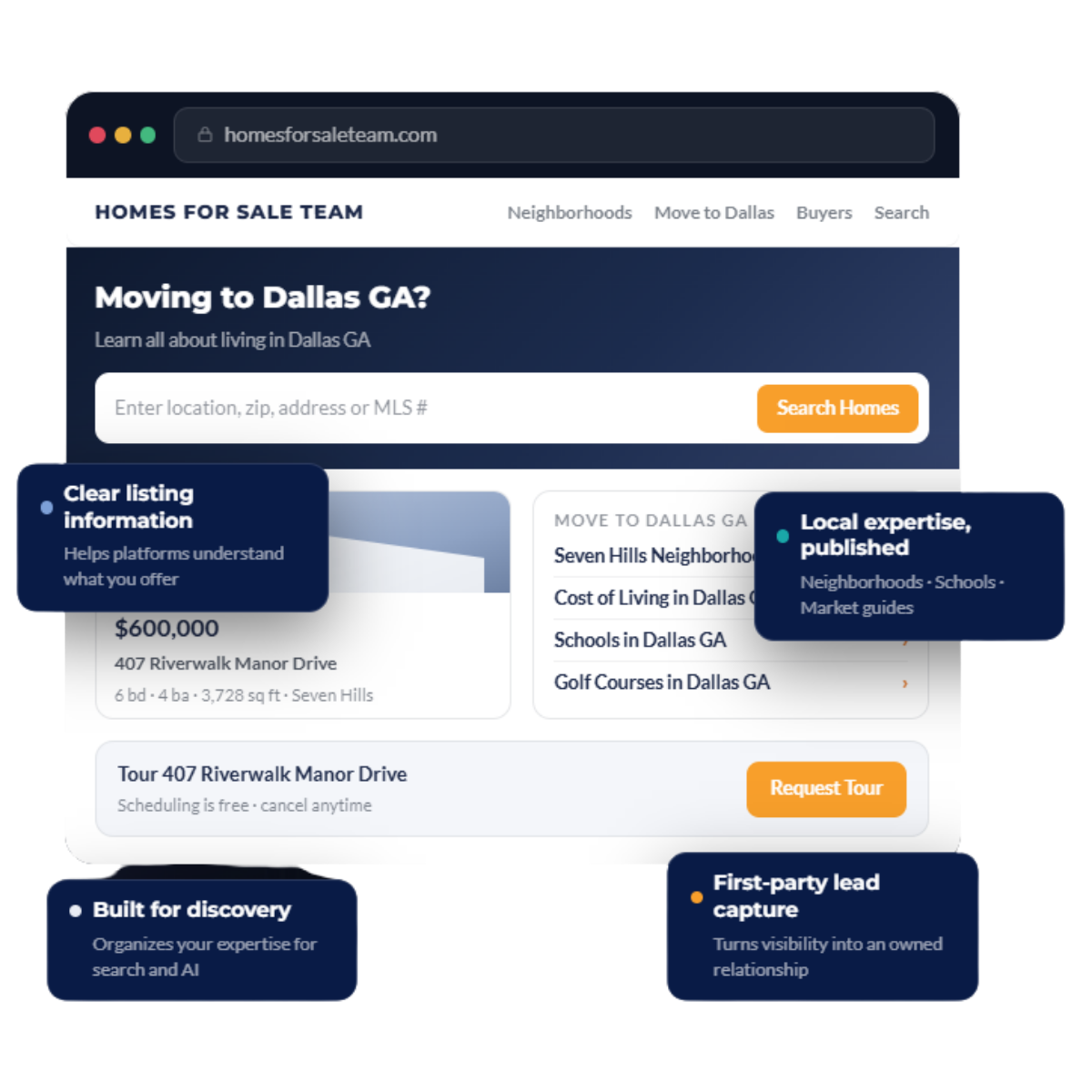
Before an assistant can evaluate your content, it has to be allowed onto your site, able to crawl it and able to parse what it finds. This pillar is the least interesting of the five and the most likely to be quietly costing you everything, because it fails silently.
Permission comes first
Your robots.txt file tells AI platforms what they may access. Most real estate websites have not updated it since before AI search became mainstream, which makes it the first gap worth checking.
There is a distinction inside that file worth understanding. You can allow AI platforms to crawl and cite your content while preventing them from using it to train their models. Those are different permissions with very different consequences. If a platform can train on your content, it can absorb your local expertise and answer future buyer questions without sending anyone back to your site or crediting you. Allowing citation while blocking training keeps your expertise working for your business rather than becoming part of someone else’s product.
Then structure and speed
Real estate schema markup, including RealEstateListing, Place, LocalBusiness, FAQPage, Person, labels information so an assistant knows what represents a price, an address, an agent, a credential. Without it, systems infer from context and frequently infer wrong. Real estate has an unusually rich schema vocabulary available, and most agent sites use almost none of it.
Schema is the clearest test of platform capability in this whole framework, because you cannot write your way to structured data. Either your platform generates it or it does not.
Alongside it: mobile load under three seconds, passing Core Web Vitals, clean URL structure, working internal links, a current sitemap, no orphaned pages. A neighborhood guide nothing links to is functionally invisible regardless of quality.
What good looks like
Your robots.txt explicitly permits AI crawling and blocks model training, schema is generated automatically rather than as a project and your site loads in under three seconds on a phone.

Pillar 4: Is your expertise easy to extract and attribute?
An assistant will not cite what it cannot cleanly extract or confidently attribute, which means formatting and authorship carry more weight than most people expect.
Two agents write equally good North End guides. One is nine dense paragraphs of genuinely excellent prose. The other covers identical ground under clear headings, including housing stock and price ranges, schools, walkability and commute and who the neighborhood suits, with specific figures stated plainly under each.
The second gets cited far more often. Not because it is better written, but because an extractable claim under an accurate heading is a safe claim to attribute. This is the pillar with the best effort-to-return ratio in the framework, because it frequently requires no new content at all, only restructuring what you have already written.
What makes content extractable
Question-shaped headings. Structure headings the way people ask. Not “Market Overview” but “Is Boise a buyer’s or seller’s market in 2026?” The heading becomes a retrieval match; the answer beneath it becomes the citation.
Answers stated immediately. Put the answer in the first sentence, then elaborate. Do not build to a conclusion – lead with it.
Genuine FAQ sections. Question-and-answer format is among the most reliably extracted structures available, and FAQPage schema makes the relationship explicit.
Tables for comparisons. Comparative information in a table is unambiguous in a way prose cannot be.
Specific, dated figures. “Median price in North End is $612,000 as of Q2 2026” is citable. “Prices in North End are relatively high” is not.
Explicit authorship. Named author, stated credentials, clear connection to the market. An assistant citing a claim is putting its own accuracy behind it, so a page with a named expert is a safer citation than an anonymous one making the identical point. “Licensed in Idaho since 2011, 400+ transactions closed in Ada County” carries signal that “passionate about helping families find their dream home” does not.
What good looks like
Question-shaped headings, answers first, tables where you are comparing, figures with dates attached and a named author with visible credentials on every page.

Pillar 5: Does the visibility you earn become an asset you keep?
A citation delivers a visitor, and what happens in the next ninety seconds decides whether you built an asset or received a compliment.
Follow the full path. A buyer asks an assistant about neighborhoods in your market. Your guide is cited. They click through. Everything before that moment was pillars one through four. Everything after determines whether the work compounds.
If they browse, leave and you never know they existed, the citation produced nothing durable. If they search properties on your domain, their behavior is captured, they convert on a relevant offer and your follow-up responds to what they actually viewed. Then the citation produced a lead, a data asset and a system slightly smarter for the next visitor.
What has to be true
Property search runs on your domain, so the session and the behavioral data stay yours. Behavior is captured, not just contact details. Knowing someone viewed four North End listings under $650K this week is intelligence; a name and email is a record. Follow-up is triggered by that behavior rather than by elapsed days, because a returning visitor is a live signal and day three is not. The data is yours, meaning you would keep the behavioral history if you changed providers. And you can attribute closed business back to the content that originated it, because otherwise you are guessing which content to build more of.
Why this is where stitched systems fail
Behavioral automation needs behavior, and behavior is generated on the website. If the website and CRM are separate systems joined by an integration, what typically crosses the boundary is a lead record: name, email, source. What does not cross is the detail. So the CRM knows a lead exists but cannot trigger on activity it never received, and much of what gets marketed as automated follow-up is really scheduled follow-up.
What good looks like
Search on your domain, behavior captured and connected, follow-up that fires on real activity and attribution you can actually read.
How do the five pillars work together?
In sequence, and the order matters because the pillars are dependent rather than parallel.
Technical foundation is a precondition. Content on a site AI cannot crawl is not competing badly, it is not competing. Ownership determines whether anything you build accumulates to you. Depth gives an assistant something worth citing. Signals make that content extractable and attributable. And lead ownership determines whether the citation becomes revenue.
Which means the pillars do not compensate for one another. Excellent local expertise on a site with no schema still struggles. Flawless structure with nothing specific to say has nothing to offer. A perfect conversion loop behind an invisible site converts nobody. The framework is closer to a chain than a scorecard, even though we score it. The weakest link sets the ceiling.
| Pillar | Depends on | Fails when |
| 3. Technical Foundation | Nothing. It is the floor | AI cannot access or parse the site |
| 1. Domain Authority | Owning the domain | Signals accrue to a portal or vendor |
| 2. Content Depth | Pillars 1 and 3 | Content is generic or syndicated |
| 4. AI-Ready Signals | Pillar 2 existing first | Expertise is buried or anonymous |
| 5. Lead Ownership | All four above | Visibility arrives and dissipates |
Which pillar should you fix first?
The weakest one, which is rarely the one people guess.
The instinct is usually to fix content, because content is visible and satisfying to work on. But if property search sits on a vendor domain, or the platform cannot generate schema, content improvements land on a compromised foundation and underperform for reasons that never become obvious.
The practical distinction worth drawing early is between gaps that are fixable on your current platform and gaps that are structural limits of it. Restructuring existing pages for extraction is a weekend of work. Moving property search onto your own domain is a different kind of decision. Both may be on your list, and confusing one for the other is how a quarter gets spent on the wrong problem.
The AI Authority Scorecard scores all five pillars in about ten minutes and separates those two categories for you. It is free and there is no form.
Why does AI authority matter now?
Because authority accumulates slowly, and the positions being established now will be difficult to displace later.
Every discovery shift in real estate has followed the same shape. An early window where effort produces outsized returns, then a long stretch where the positions set in that window hold. Agents who invested in SEO while competitors bought newspaper ads built organic engines still producing a decade later. The advantage came from being earlier, and then from the fact that authority compounds.
The industry has an estimated 18-month window before AI citation patterns solidify. Sierra clients are being cited in AI answers right now, and content authority takes months to build, which is the argument for starting rather than waiting.
Real estate AI traffic growth and the 18-month window are Sierra Interactive market observations presented as context and trajectory, not certainties.
FAQ
What is AI authority in real estate?
AI authority is the combination of signals that determines whether an AI assistant will cite your real estate website when answering a buyer’s question. It rests on five pillars: domain authority and ownership, content depth and local relevance, technical SEO foundation, AI-ready content signals and lead ownership and compounding.
What are the five pillars of AI authority?
Domain Authority & Ownership, which determines whether the authority you build accrues to you. Content Depth & Local Relevance, whether your content is specific enough to be worth citing. Technical SEO Foundation, whether AI can find, crawl and trust your site. AI-Ready Content Signals, whether your expertise can be extracted and attributed. And Lead Ownership & Compounding, whether the visibility you earn becomes an asset you keep.
What is Generative Engine Optimization (GEO)?
Generative Engine Optimization is the practice of optimizing content to be cited inside AI-generated answers rather than ranked in a list of links. It is closely related to Answer Engine Optimization (AEO), and the terms are often used interchangeably. Both describe the same underlying work the five pillars cover.
Is GEO different from SEO?
They overlap substantially but optimize for different outcomes. SEO optimizes for a position among ten links, where page one still earns traffic. GEO optimizes for being one of the two to four sources named inside a generated answer. The technical foundation is largely shared, but GEO places more weight on content depth, structured data, extractable formatting and verifiable authorship.
Which pillar of AI authority matters most?
Whichever is weakest, because the pillars do not compensate for each other. Technical foundation is the precondition. Nothing else gets evaluated without it, but a technically flawless site with generic content has nothing worth citing. The framework behaves more like a chain than a checklist, and the weakest link sets the ceiling.
How long does it take to build AI authority?
Technical fixes and content restructuring can be completed in roughly 30 days and often produce early gains. Meaningful content depth usually takes several months to build and begin earning citations. Compounding effects generally become significant over one to two years. Anyone promising faster than that is overselling.
Does my property search need to be on my own domain?
For AI authority purposes, yes. Property search is typically the highest-engagement, longest-session, most-linked content on a real estate website, and across Sierra Interactive sites, property listings are the largest source of AI referral traffic. Hosting search on a vendor subdomain means that signal builds the vendor’s domain authority rather than yours.
Can I build AI authority without changing platforms?
Partly, and it depends which pillar is weakest. Content depth and AI-ready signals are largely editorial. You can act on both immediately on almost any platform. Technical foundation and lead ownership are substantially determined by the platform, particularly schema generation and whether property search and CRM share data natively. That is why it is worth identifying which category your gaps fall into before spending anything.
Does AI authority replace traditional SEO?
No. They reinforce each other. Traditional SEO helps people find your site through search engines, and much of its technical foundation is what makes your content accessible to AI in the first place. AI authority adds the requirements that determine whether an assistant will cite you once it can read you.
Can any platform guarantee AI recommendations?
No. AI systems are proprietary and change frequently, so any vendor promising specific citation outcomes is overselling. What can be done is to build the inputs that consistently correlate with being cited: an owned domain, genuine content depth, a sound technical foundation, extractable and attributable structure and a conversion loop that keeps what you earn.
The takeaway
The websites AI recommends are not the newest or the most visually impressive. They are the ones built on a domain the owner controls, filled with content specific enough to be worth citing, structured so a machine can extract it, attributed so a machine can trust it and wired so that visibility turns into something durable.
That is not one project. It is five, and they are dependent on each other in a specific order. Knowing which one is your constraint is the difference between a quarter well spent and a quarter spent on the wrong problem.