We Analyzed Thousands of Real Estate Blog Posts: Here’s What Gets Cited in AI Search
Real estate content has always been a point of both contention and confusion for agents.
And with AI content being so prevalent, it’s creating a layer of risk for agents that they don’t know about. You’re being told ‘create more local content for AI search’ without guidance on the topics, the relevance, or any optimization tips.
This post-it-and-see strategy won’t work.
So, instead of speculating, I investigated the state of local content in real estate.
In hopes that I can show you exactly what type of content you need to produce and what types of content (and content strategy) will ruin your chances of ranking in any AI search engine.
Different types of local content for real estate
I break down local content for real estate into 10 main categories:
- Listings
- Service areas
- Neighborhood guides
- Buyer content
- Seller content
- Specialist content
- Leisure
- Generic
There are 2 core intent types: informational and commercial.
Note: You can break these intents down further into navigational (i.e., I want to go somewhere) and hybrid (i.e., I’m researching while making a decision).
For simplicity, I’m using these content categories to guide the rest of my analysis. I may be missing additional types of local content, but the categories I’ve selected are the most commonly used.
The data we used to analyze local content
My methodology for analyzing and ranking the effectiveness of local content in AI search for real estate agents is simple.
- How much traffic do these pages generate?
- How many times are these pages cited by AI search?
- How many keywords do the pages rank for?
- What’s the ratio of content with traffic vs. without?
- How relevant is the content to real estate?
To do this, I’m using both Ahrefs and DataForSEO to collect the data.
Disclaimer: This is third-party data, so the numbers may be different from first-party data such as Google Analytics or Google Search Console. Still, the data will be directionally sound to give us an indication of performance.
Finding #1: Most real estate blog content generates no traffic
We at FlyDragon randomly analyzed 11,360 residential real estate sites to collect traffic data across a mix of CMS providers to stay fair.
Of those 11,360 sites, 6,644 generated no traffic in the last 30 days. That’s 58% of real estate agents who have paid for a website that is, essentially, giving them no organic visibility in return.
Here’s the full picture:
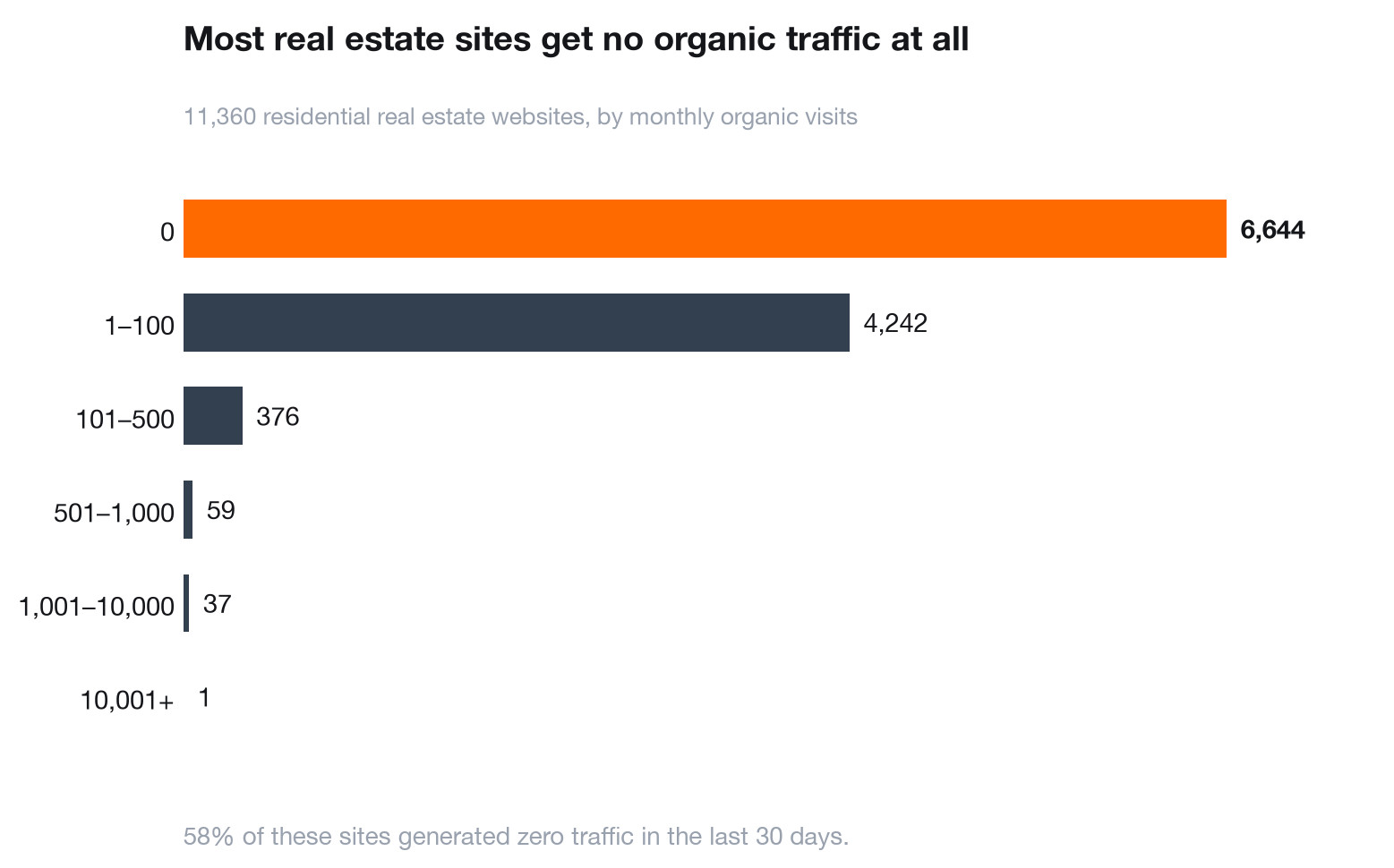
For the sake of clarity, the exact numbers:
- 0: 6,644
- 1-100: 4,242
- 101-500: 376
- 501-1000: 59
- 1001-10,000: 37
- 10,0001+: 1
Keep in mind that a lot of these agents are currently paying a monthly fee for ‘real estate SEO’ or ‘real estate blogs’ when, in fact, they’re paying for an empty promise.
Finding #2: Over half of all real estate websites have 0 AI citations
We took a random selection of 1,000 domains from our main list to see how many AI models cited them.
Cited means the website was linked to within the AI answer. Not to be confused with being sourced or mentioned.
We balanced the sample across Domain Rating bands so authority was fairly represented, and we measured every site above DR 20 in full rather than sampling. DR means Domain Rating and is a third-party scoring system out of 100 to derive the strength of a website’s backlink profile.
52.4% have never been cited by a single AI model.
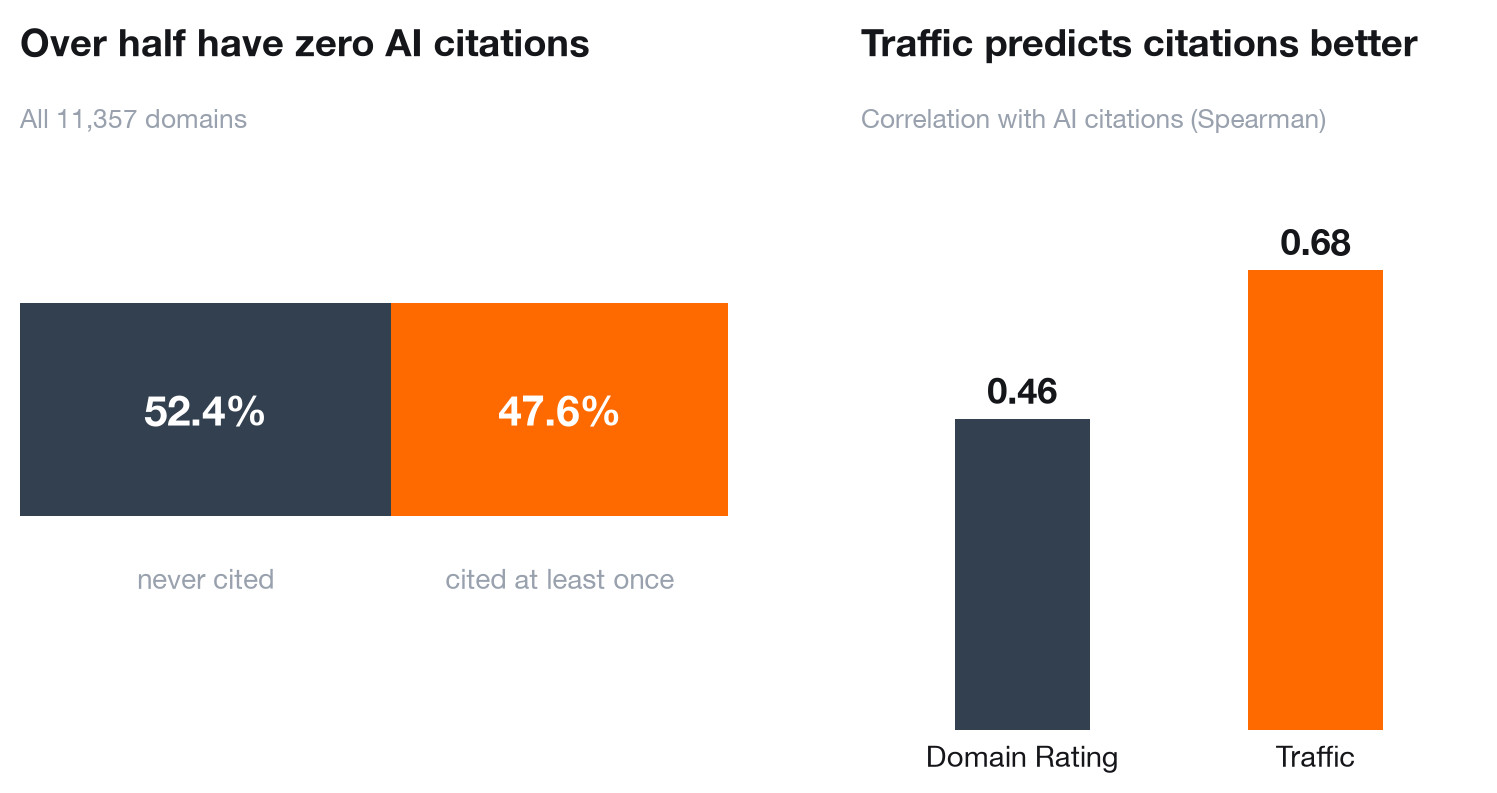
This highlights a common assumption that needs to be dispelled: you do not need to be a huge authority agent to win in AI search. DR correlates at 0.46, whereas traffic correlates at 0.68.
Traffic always wins.
If we split the whole list by traffic, look at the AI citation pattern of being cited at least once. This is important; we’ll come back to that:
0: 30%
1-100: 71.9%
101-500: 82.6%
501-1,000: 93.2%
Above 1,000: 93.5%
Nearly 1 in 3 sites with zero traffic still turn up in an AI answer somewhere. Roughly 2,000 real estate websites show up.
How?
Finding #3: Being cited doesn’t mean good content
Sites with no traffic but still at least 1 page cited in AI sounds… wrong.
We found that sites with 0 traffic still had at least 1 link cited by AI. Roughly 58% of the 1,000 domains we analyzed had a random ‘brand’ event.
But when AI is expected to go deeper than what is more than likely the homepage, those numbers drop dramatically. This highlights not only the importance of content depth, but also quality.
The correlation between traffic and citations proves that.
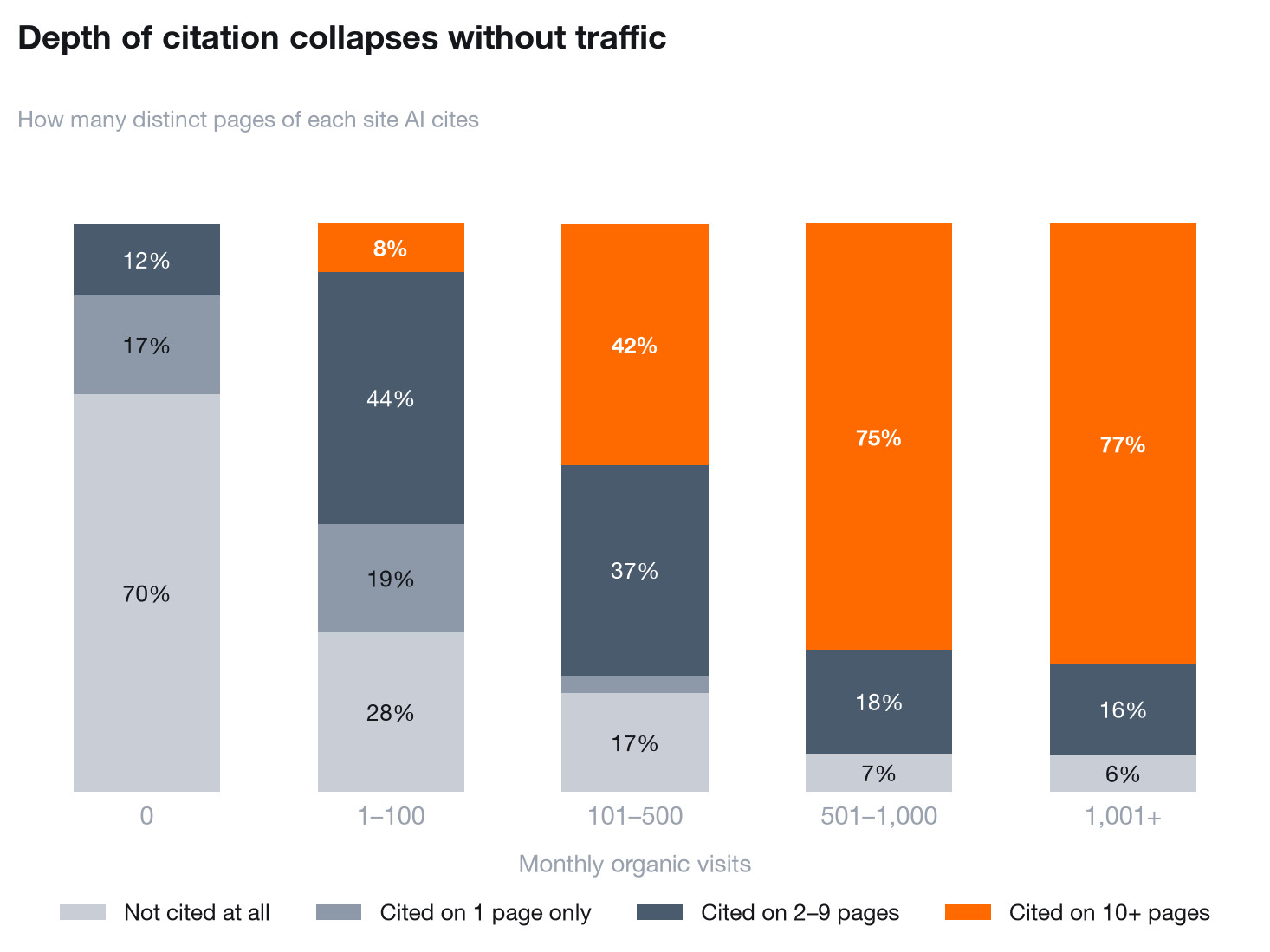
This shows that in order to be cited by AI over 90% of the time, you need at least 500-1,000 visits per month. This is a citation show rate of roughly 10%. In short: As organic visibility increases, AI citation depth increases dramatically.
Finding #4: The content cited the least was service area pages
The least-cited content across the 1,000 domains we analyzed wasn’t a surprise. The core pages of any real estate agent’s site never made it into AI’s index.
This highlights one thing: agents underindex the pages that will get them the most listings from AI search.

The local content that loses the most follows this very distinct pattern:
- Content lacks a ‘decision’ or ‘goal’ for the end user to complete.
- Broad, generic head terms always lose to major portals or sites outside of real estate.
- Content classified as ‘thin’ (listing pages, service area pages, about/content)
So, the advice “just publish more local content” is only half right. Local isn’t enough. Useful isn’t enough.
The content you produce as an agent has to be uniquely positioned to you, your expertise, and your ability to answer a very specific question. A narrower target audience means higher-intent searches and a significantly higher chance of agents ranking for it.
This thinking should extend into every possible route that leads to a listing conversation. Looking at that data, you should understand that least cited doesn’t mean it shouldn’t be cited.
Property listings can be more than just an IDX feed with no information. Sierra Interactive does a great job of this, which is why their commercial pages disproportionately win in search compared with other providers.
The overwhelming majority of Sierra’s websites do three things incredibly well that most other CMS providers do not:
- They build really specific commercial pages, like “ranch homes for sale in Texas” instead of generic searches. It’s a much better match for what someone is actually looking for and gives the page a clear purpose.
- They interlink neighborhoods and locations by default, so pages aren’t just sitting out there on their own. And because it all lives on the agent’s domain, the value and authority they’re building stays with them instead of going to a portal or third party.
- The commercial pages aren’t just listing grids. They’re adding actual context around the search, like market info, buyer guidance, and local details. That gives AI something useful to pull from and attribute beyond just raw MLS data.
Why does this work? If you look at the data, the most important pages agents overlook all have commercial intent but lack the content to support AI models picking them up.
Sierra adds content blocks such as:
- Common questions
- History of the market
- Introduction to the market
Imagine you’re speaking to someone moving to a market they’ve never been to before… what questions would they ask?
That’s what your listing pages need to contain to be cited, and that’s why, from a professional perspective, I’d choose Sierra if I were an agent who wanted to be cited more by AI search engines.
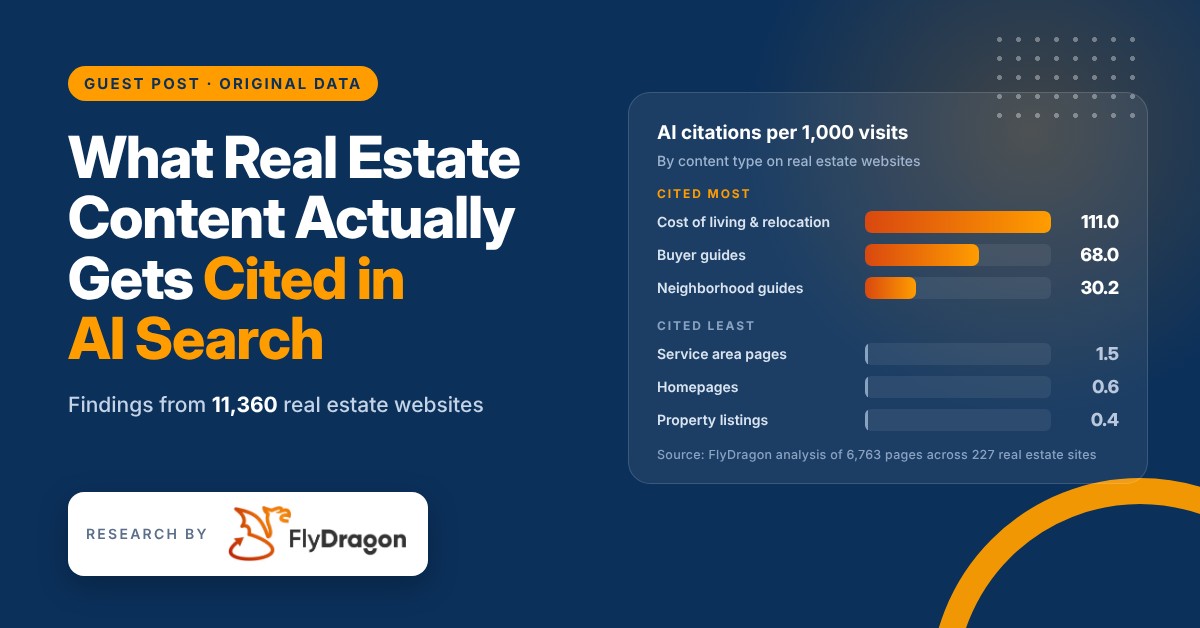
Finding #5: The content cited the most was neighborhood guides
As expected, the most-cited content is where an agent is the best option for the answer.
At FlyDragon, we’ve been saying this for 18 months. Your content needs to be planned around what people are asking before they decide. It needs to ladder up to a conversion… nobody (and I mean nobody) needs another pointless blog about ‘the best place to get a pumpkin latte this Halloween’.
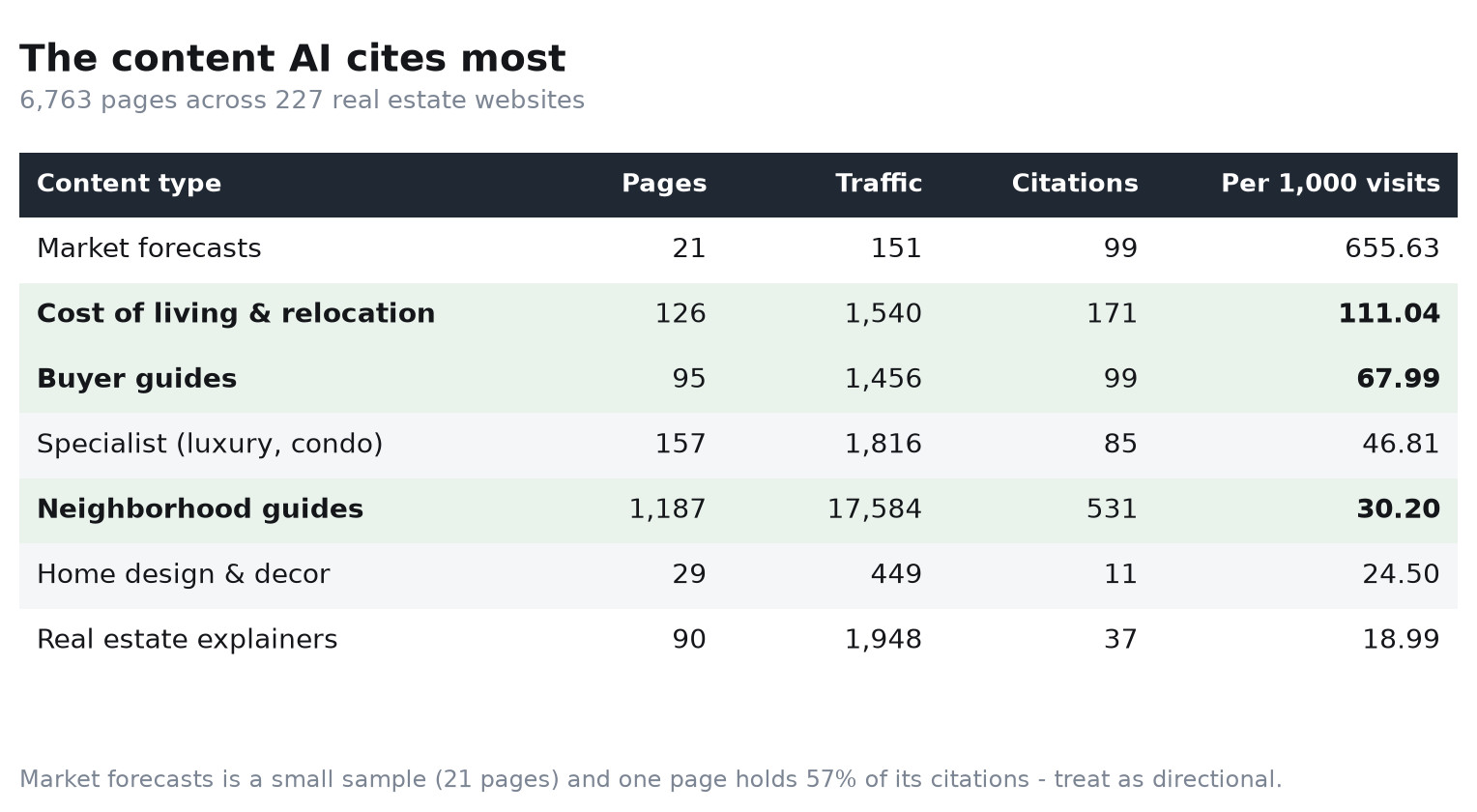
The most common and predictable type of content that wins is location-anchored lists.
For example:
- 11 best neighborhoods to live in Albuquerque
- The most exclusive neighborhoods in Beverly Hills
- Top 5 neighborhoods in Victoria BC
AI search favors content that its crawlers can easily digest. And lists seem to be serving that intent by quite a distance.
What local content should agents create for AI search?
The data shows there are 4 main categories of content that apply to any market. Luxury/celebrity is a big opportunity, but it doesn’t translate to every agent, and so, for that reason, we’re excluding that.
- Lists for a place (top X, best Y)
- Comparison pages (Buckhead vs Midtown, condo vs loft)
- Forward-looking market forecasts.
- Costs and fees.
The reason why this local content dominates weaker, filler content is how helpful the topic is to your client. Somebody looking for a real estate agent to work with doesn’t care about the “best pickleball courts”.
Secondly, none of that content ranks.
There is no thinking behind it and no data to support it. It’s why working with an AI SEO agency dedicated to the craft is considerably more advantageous than working with a website provider who ‘writes blogs for you’.
And that’s not a slight at any provider.
But just because you can provide content doesn’t always mean that you should (and the data proves it).
Author

Related Posts

Real Estate Website
The Best IDX Website Platforms for Real Estate...

Real Estate Website
Real Estate Community Pages: How to Build Neighborhood...

Real Estate Website
SEO for Real Estate Websites: How to Rank...

Real Estate Website