AI Authority vs. Just Another Real Estate Website: What Sets Recommended Brands Apart
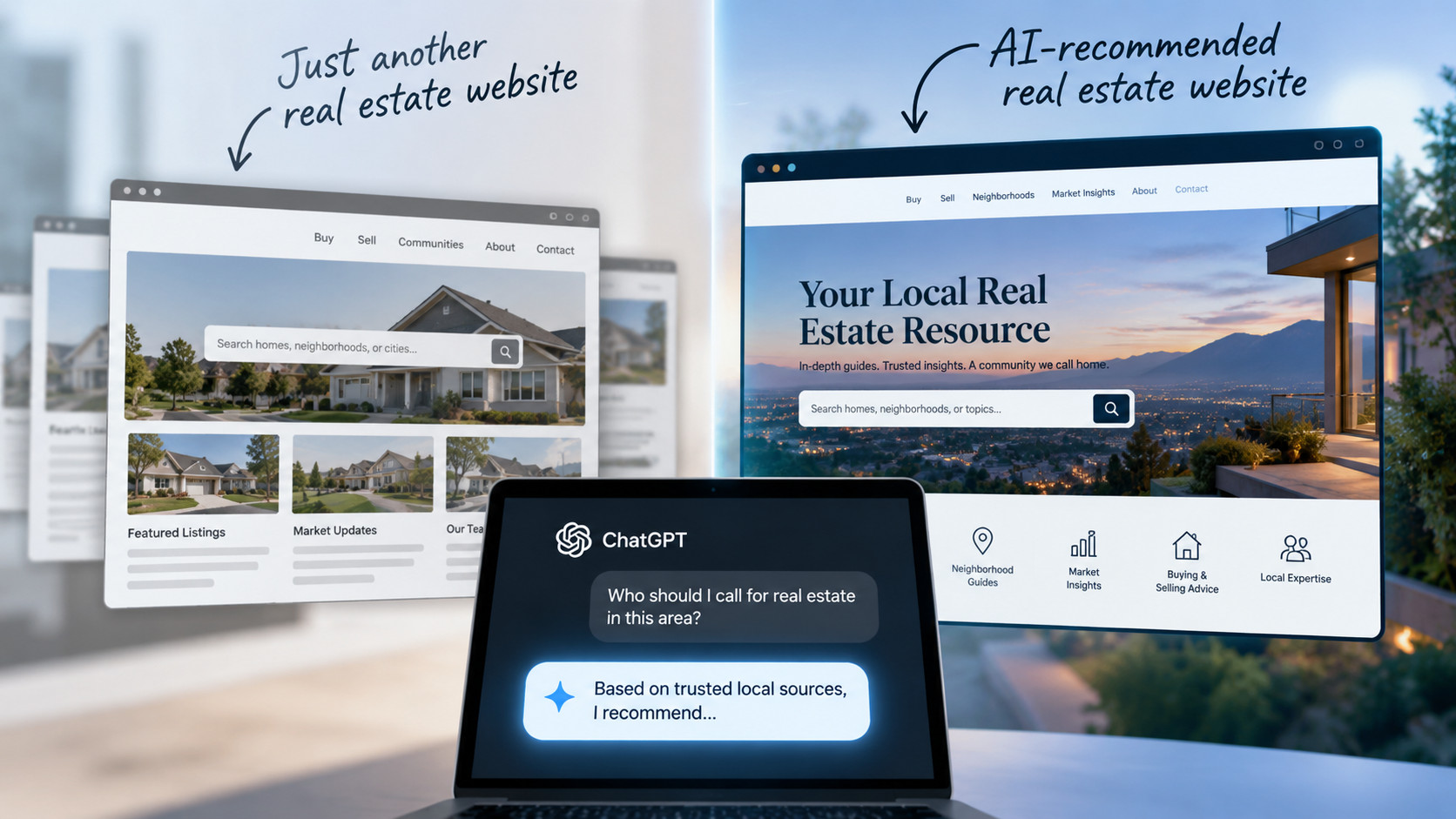
Two real estate websites. Both modern. Both fast. Both ranking respectably on Google.
A buyer asks ChatGPT who to call in that market, and one of them gets named. The other does not appear at all.
The difference is almost never design, and it is rarely effort. It is five structural things, and most of them were decided by the platform before a single page was published.
If you want the mechanics of how AI evaluates a site, we covered that separately in How AI Chooses Which Real Estate Websites to Recommend. This post is about the decision that sits underneath it: what to look for when the platform itself is what needs to change.
What makes a real estate website “just another website”?
Not being bad. Being indistinguishable.
A typical modern real estate site does several things well. It looks current, loads acceptably, has property search, captures leads and publishes a blog. Judged as a brochure, it is fine. Judged as a source an AI assistant might cite, it has a specific problem: there is no question it is the best answer to.
Its neighborhood pages are listing grids with an introductory paragraph. Its market updates could describe any city. Its property search runs on a vendor subdomain. Its content carries no author. Nothing about it is wrong. Nothing about it is citable either, because being cited requires being the best available answer to something specific, and generic sites are not the best answer to anything.
What do AI-recommended real estate websites do differently?
Five things, and they are cumulative rather than optional.
| Pillar | Just another website | An AI-authoritative website |
| Domain Authority & Ownership | Property search on a vendor subdomain, presence spread across portal profiles | Everything on one owned domain, including search |
| Content Depth & Local Relevance | Listing grids with introductory paragraphs, market posts that fit any city | A real guide per neighborhood, with interpretation only a local could write |
| Technical SEO Foundation | Schema absent or partial, robots.txt untouched since before AI search | Real estate schema by default, AI crawling explicitly permitted |
| AI-Ready Content Signals | Dense prose, no bylines, undated claims | Question-shaped headings, answers first, named authors with credentials |
| Lead Ownership & Compounding | Leads captured, behavior discarded | Behavior captured and connected, follow-up fires on real activity |
Read down the right column and a pattern emerges. None of it is about aesthetics, and only two of the five are really about effort. The other three were determined by the platform.
Why can’t you fix this with better content alone?
Because content sits on top of three things it cannot change.
Schema is not something you can write your way to. Either the platform generates it or it does not. Property search on a vendor domain sends your strongest engagement signal somewhere else no matter how good your guides are. And a website and CRM joined by an integration rather than sharing data natively cannot trigger follow-up on behavior the CRM never received.
This is the distinction worth drawing before you spend anything: some gaps are fixable on your current platform, and some are structural limits of it. Restructuring existing pages for extraction is a weekend of work. Moving property search onto your own domain is a different kind of decision. Confusing the two is how a quarter gets spent on the wrong problem.
What questions should you ask a website platform?
Five questions that cut through most website platform marketing.
1. Is my property search hosted on my own domain, or on yours? Ask for the actual URL a buyer sees. “It looks like your domain” and “it is your domain” are different answers.
2. Does the platform generate real estate schema automatically, and which types? A capable vendor names them: RealEstateListing, Place, LocalBusiness, FAQPage, Person. “SEO optimized” means no.
3. What do typical client sites score on mobile Core Web Vitals? If they do not measure it, they are not managing it. Ask for live client URLs you can test yourself.
4. How does on-site behavior reach my follow-up? Not whether – how. Native, or via integration? Which behaviors are available as triggers?
5. If I leave, what do I keep? Content, domain, contacts, behavioral history. Ask about export formats, not principles.
A vendor confident in what they have built will answer all five directly, with specifics and live examples. Deflection is information.
Does this mean design does not matter?
It matters, and it matters at a different point in the process than most people assume.
Design does not earn the citation. Nothing about how a site looks affects whether an assistant can crawl it, parse it or find something specific worth quoting. But once a recommendation is made, the buyer clicks through and makes a two-second judgment: does this look credible, does this answer my question, does this feel like someone who knows this market? Design decides that.
Which is the useful way to hold both facts. Structure earns the recommendation. Design converts it. A beautiful site that AI never cites gets no chance to convert anyone, and an authoritative site that looks abandoned wastes the citation it earned.
Where should you start?
By finding out which of the five is actually your constraint, because it is rarely the one people expect.
Most teams assume content. Often it is schema, or property search sitting on a vendor domain, or a conversion loop that quietly drops every visitor AI sends. Those look identical from the outside (e.g., “we are not showing up”) and they call for entirely different responses.
The AI Authority Scorecard scores all five pillars in about ten minutes and separates the fixable gaps from the structural ones.
FAQ
What makes a real estate website AI-friendly?
Five things: everything of value lives on a domain you own, including property search., content is specific and locally expert, real estate schema is generated automatically, content is structured so claims are extractable and attributable and visitor behavior is captured and connected to follow-up. Design is not among them.
Does website design affect AI search visibility?
Not directly. Design does not affect whether AI can crawl your site, understand it or find something specific worth citing. It matters after the recommendation, when a buyer clicks through and decides in about two seconds whether the source looks credible.
Can I improve AI visibility without changing platforms?
Partly, and it depends which pillar is weakest. Content depth and content structure are editorial and can be improved on almost any platform. Schema generation, property search domain and whether website and CRM share data natively are largely determined by the platform. That is why it is worth identifying which category your gaps fall into first.
Why does property search need to be on my own domain?
Property search is typically the highest-engagement, longest-session, most-linked content on a real estate website and property listings are a leading source of AI referral traffic. Hosting it on a vendor subdomain means that signal builds the vendor’s domain authority rather than yours, and it fragments your site architecture at the same time.
What is the difference between ranking and being recommended?
Ranking is a position in a list of ten links, where page one still earns traffic even at position seven. Being recommended means being one of the two to four sources an AI assistant names inside an answer. There is no eleventh slot and no second page, so the outcomes are far less forgiving.
How do I evaluate a real estate website platform for AI search?
Ask five questions: is property search on my own domain, does the platform generate real estate schema automatically and which types, what do client sites score on mobile Core Web Vitals, how does on-site behavior reach my follow-up system and what would I keep if I left. Ask for live client examples rather than slides.
The takeaway
The websites AI recommends are not the newest or the best looking. They are the ones where the authority accumulates to the owner, the content is specific enough to be worth quoting, the technical foundation lets a machine read it, the structure lets a machine extract it and the conversion loop keeps what the citation delivered.
Two of those five you can start on this week. Three of them your platform already decided. Knowing which is which is the whole of the decision