Build vs. Buy: Should Your Real Estate Team Build Its Own Website or Hire a Vendor?
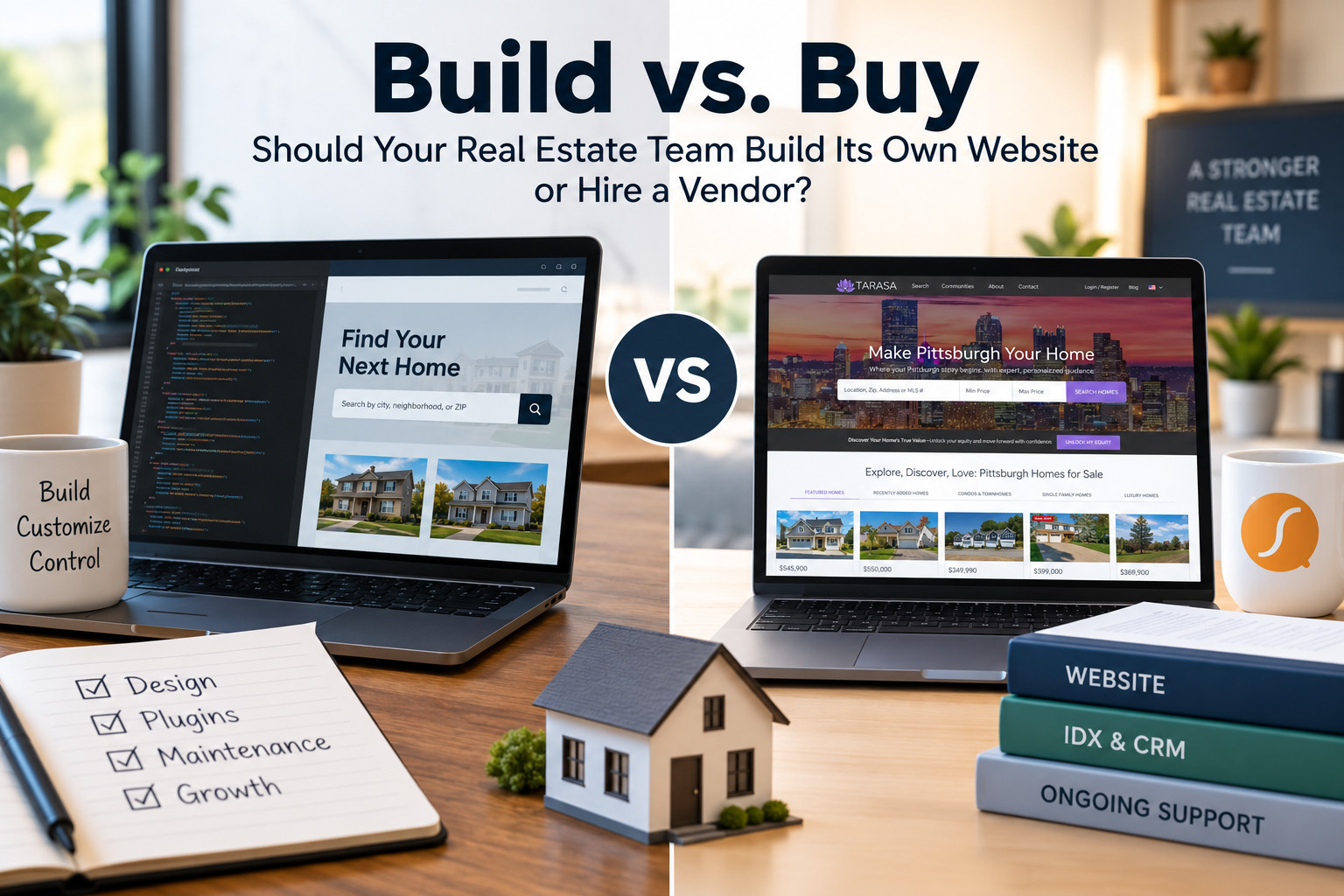
Short answer: Build your own real estate website when you have a dedicated technical resource, a content-first growth strategy and no urgent need to connect site behavior to follow-up. Hire a vendor when your team is growing, leads arrive from multiple sources and every hour spent on plugin maintenance is an hour not spent converting. For most teams between 5 and 25 agents, the deciding factor isn’t cost or design. It’s whether website activity reaches an agent fast enough to matter.
That answer gets messier in practice, because “build your own” isn’t one option and “hire a vendor” isn’t one option either. Here’s how to tell which path fits your team, what each one actually costs over three years and the seven questions that settle the decision.
What’s the difference between building your own real estate website and hiring a vendor?
There are really three paths, not two, and they behave very differently once your team starts growing.
| Path 1: General site builder | Path 2: WordPress + IDX plugin | Path 3: Purpose-built platform | |
| What it is | Squarespace, Wix or similar with an embedded search widget | Self-hosted WordPress, a real estate theme, an IDX plugin and a separate CRM | A single product where site, property search and CRM are one system |
| Who assembles it | You | You, or a developer you hire | The vendor |
| Who maintains it | You | You (updates, security, plugin conflicts, feed breakage) | The vendor |
| Where leads land | A form inbox or a connected CRM | A CRM you integrate yourself, usually via a bridge tool | Directly in the CRM, with the behavior attached |
| MLS compliance | Your responsibility | Yours and your plugin vendor’s, jointly | The vendor’s, as part of the feed relationship |
| Typical time to launch | Days | Weeks to months | Weeks |
| Best fit | A solo agent who needs presence, not pipeline | Content-led brands with technical support on staff or on retainer | Teams whose revenue depends on speed to lead |
Path 2 is the one most “build it yourself” conversations are actually about, and it’s the one this post spends the most time on because it’s genuinely good at some things and genuinely fragile at others.
When does building your own real estate website actually make sense?
Building your own is the right call more often than vendors like to admit. Choose it when several of these are true:
- You have a developer. Not “a friend who knows WordPress” – someone accountable for updates, backups, uptime and the 11 p.m. call when the feed stops syncing.
- Content is your primary growth channel. If your plan is 200 neighborhood guides, market reports and long-form local content, you want unconstrained control over templates, URL structure and internal linking.
- Your brand needs an unusual design. Luxury, new construction and niche commercial brands sometimes need layouts no template accommodates.
- You’re running one market and one agent. Complexity scales with agents, markets and lead sources. With one of each, the maintenance burden stays small.
- You want maximum portability. A well-built WordPress site is comparatively easy to move. Content, URLs and redirects come with you.
If four or more of those describe you, stop reading vendor comparisons and go build. The rest of this post is about what changes when they stop being true.
When should a real estate team hire a vendor instead?
The shift usually happens somewhere between the third and tenth agent, and it’s rarely announced. Hire a vendor when:
- Leads arrive from more than two sources. Organic, Zillow, Realtor.com, Google Ads, Meta, open houses, past clients. Each source needs routing rules, and stitched-together systems route poorly.
- Speed to lead determines your close rate. A lead form that emails a shared inbox is not a routing system. Neither is a Zapier chain with a five-minute delay.
- You need behavioral context, not just contact details. Knowing a lead viewed six properties in one ZIP code in 20 minutes changes the call. That signal lives in the property search, and it only reaches your CRM automatically if the two are one system.
- Agents come and go. Every roster change means reassigning leads, adjusting permissions, and updating agent pages. On a DIY stack that’s manual work in three places.
- Nobody on your team wants to own uptime. This is the honest one. Most growing teams don’t have a person for this, they have a person who does it in addition to their real job.
According to NAR’s 2025 Technology Survey, only 38% of agents agree their brokerage provides all the tech tools they need. Which means the assembly problem lands on individual teams by default.
What does a DIY real estate website really cost?
The sticker comparison favors DIY. The three-year comparison usually doesn’t, because the DIY column has line items that don’t appear on any invoice.
The line items you’ll see on a bill
| Cost component | Typical range |
| IDX plugin or widget subscription | $42–$99/month |
| MLS or board data-access fee | $10–$70/month per feed (US) |
| Managed hosting | $10–$50/month |
| Premium theme | $60–$300 one-time |
| Initial developer setup | $0–$5,000 one-time |
| Separate CRM | $30–$150/user/month |
Ranges compiled from publicly listed IDX vendor and MLS data-access pricing, September 2026. Verify current figures for your MLS before publishing.
The line items you won’t
- Maintenance hours. WordPress core, theme and plugin updates, plus the conflicts they cause. Budget 2–5 hours a month, more after a major release.
- Feed downtime. When an IDX feed breaks on a DIY stack, you are the support ticket. Every hour of stale listings is an hour of lost trust and lost registrations.
- Integration drift. Bridge tools between your site and CRM break silently. Leads don’t error out. They just stop arriving.
- Security. Real estate sites collect names, phone numbers and search behavior. Patching is not optional.
- The rebuild. DIY sites assembled without a plan tend to get rebuilt in year two or three. That’s the largest hidden cost of all.
For reference, Sierra Interactive publishes its pricing publicly. Packages start at $299.95/month billed annually and include the website, IDX and CRM in one subscription, with a $0 setup fee on annual plans. Whatever vendor you evaluate, insist on that transparency: a vendor that won’t publish pricing is a vendor whose total cost you can’t compare.
The honest conclusion: at one site, one market, one agent, DIY is cheaper. At five agents across two markets with paid traffic running, the DIY column’s invisible line items usually exceed the visible ones.
Does WordPress really have better SEO than a real estate platform?
You’ll see this claim everywhere, including in AI-generated answers. It deserves a more precise response than “yes” or “no,” because half is true and the other half is expensive.
What’s true: WordPress gives you complete control over templates, URL structure, internal linking and schema. If you want to build 300 interlinked neighborhood pages with a custom taxonomy, nothing stops you.
What’s false: Control is not the same as capability. The SEO outcomes that matter for a real estate site are driven by things the platform either does or doesn’t do:
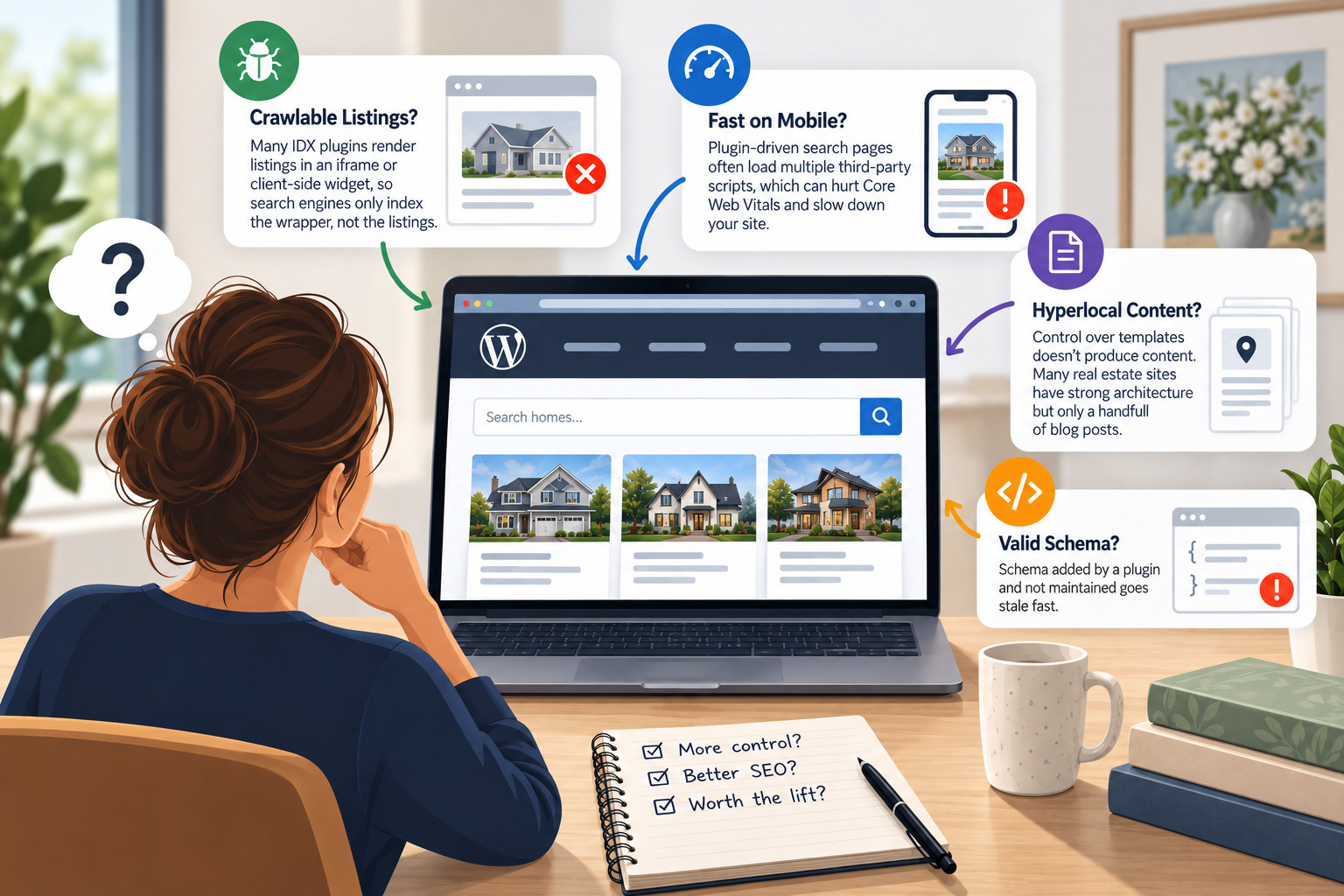
- Are listing and search pages crawlable and indexable? Many IDX plugins render results in an iframe or client-side widget. Search engines index the wrapper, not the listings — which means the single largest body of content on your site contributes nothing.
- Is the property search fast on mobile? Core Web Vitals on a plugin-driven search page loading third-party scripts is a recurring, expensive problem.
- Do hyperlocal pages actually exist? Control over templates doesn’t produce content. Most DIY real estate sites have magnificent SEO architecture and 11 blog posts.
- Is schema valid and maintained? Schema added by a plugin and not maintained goes stale fast.
The accurate framing is this: WordPress gives you a higher ceiling and a much lower floor. A well-resourced team with a developer and a content operation will beat a template. An under-resourced team on WordPress will lose to a purpose-built platform that ships crawlable search, fast pages and editable metadata by default.
So the real question isn’t “which platform has better SEO.” It’s “which platform will my team actually execute SEO on?”
What breaks first when a growing team runs its own website?
Predictable failure order, in our experience with teams migrating off DIY stacks:
- Lead routing. A form posts to an inbox. Someone forwards it. Twenty minutes pass. The lead has already spoken to someone else.
- Attribution. Marketing can’t tell which source produced closings, so budget decisions get made on gut feel.
- Behavioral data. Search activity stays trapped in the IDX widget instead of reaching the agent making the call.
- The feed. A plugin update, an MLS schema change or a lapsed data agreement takes listings offline.
- Agent onboarding. Adding an agent becomes a 45-minute manual task across three systems.
- The blog. Whoever was writing it stops, because they’re now doing items 1 through 5.
None of these are arguments against building your own site. They’re arguments for being honest about who owns each one.
How does AI search change the build vs. buy decision?
This is new enough that most build-vs-buy comparisons haven’t caught up.
Buyers increasingly start with ChatGPT, Google AI Overviews or Perplexity rather than a search box. Those systems don’t rank pages, they extract answers and cite sources. Getting cited depends on things that are structural:
- Clean, valid schema so your content is machine-readable.
- Fast, server-rendered pages that AI crawlers can actually parse.
- Hyperlocal, specific, factual content that answers real questions. The kind of content AI systems quote.
- Consistent entity information across your site so a model can tell who you are and what market you serve.
On a DIY stack, every one of those is a project you own. On a purpose-built platform, some are defaults. Sierra’s website platform ships schema markup, server-side rendering and editable metadata out of the box rather than as plugin add-ons.
The strategic point holds either way: AI citation patterns form early and persist. A team that waits until its DIY site is “finished” to think about AI search will be competing against teams that have been accumulating citations for a year.
The build vs. buy decision scorecard
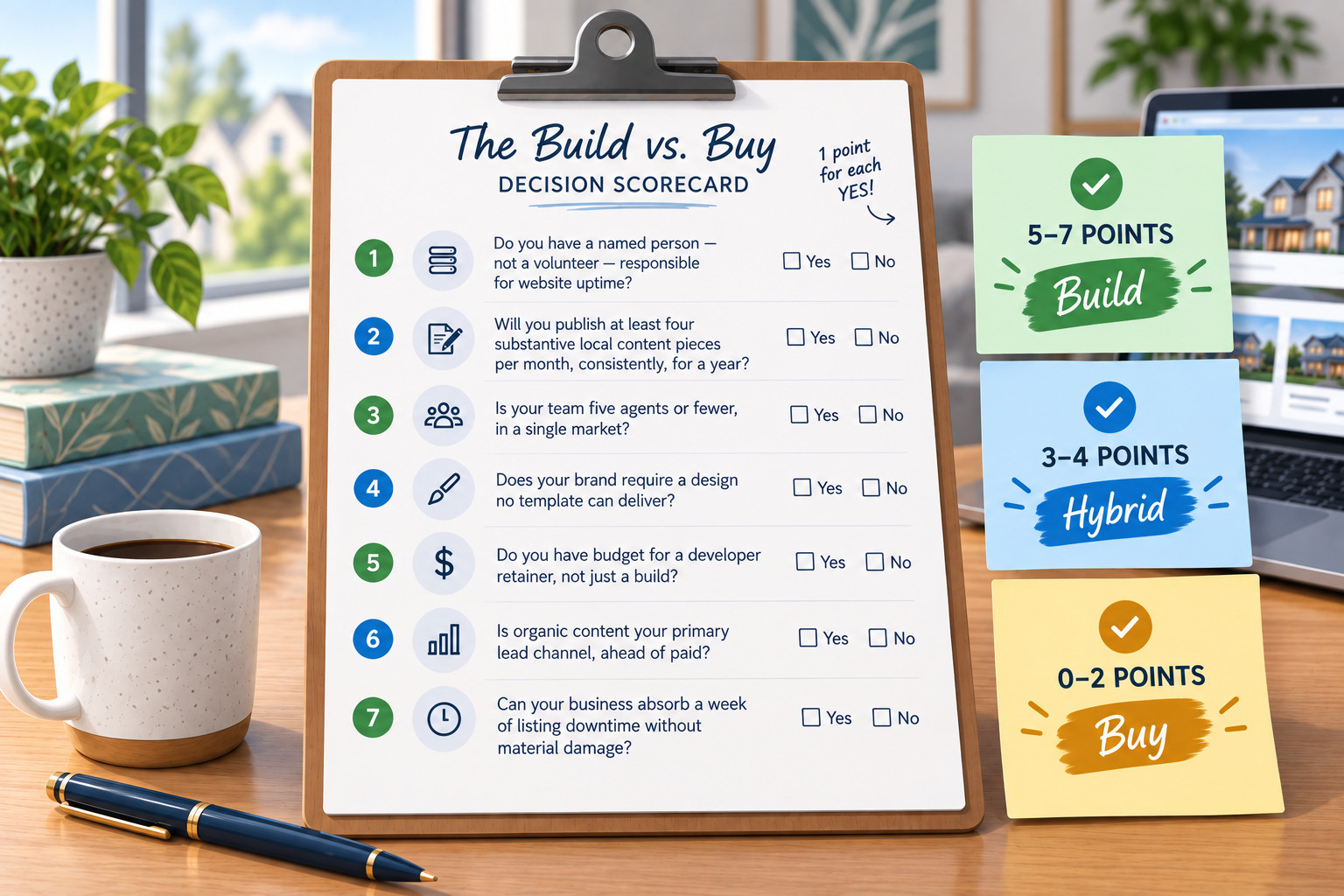
Score one point for each yes. This takes about two minutes.
- Do you have a named person, not a volunteer, responsible for website uptime? (1 pt = build)
- Will you publish at least four substantive local content pieces per month, consistently, for a year? (1 pt = build)
- Is your team five agents or fewer, in a single market? (1 pt = build)
- Does your brand require a design no template can deliver? (1 pt = build)
- Do you have budget for a developer retainer, not just a build? (1 pt = build)
- Is organic content your primary lead channel, ahead of paid? (1 pt = build)
- Can your business absorb a week of listing downtime without material damage? (1 pt = build)
5–7 points: Build. You have the resources and the strategy to use the higher ceiling. 3–4 points: Hybrid. Consider a platform for the core site and CRM, with custom content built on top. 0–2 points: Buy. Your constraint is execution capacity, not platform capability, and a DIY build will consume the capacity you’d otherwise spend converting leads.
What to ask any real estate website vendor before you sign
If the scorecard points toward buying, these seven questions separate vendors quickly:
- Are property search and listing pages server-rendered and indexable?
Ask to see a listing page’s rendered source, not a screenshot. - Can I edit URLs, meta titles, meta descriptions and schema myself?
If the answer is “our team handles that,” your SEO velocity is capped by their ticket queue. - What happens to my content and URLs if I leave?
Ask specifically about content export, redirect maps and blog migration. - Does behavioral data from the search reach the CRM automatically, or through an integration?
“Through an integration” means it can break. - How many MLS feeds are supported, and who manages the compliance relationship?
- Is pricing published?
If you have to ask, you can’t compare. - What’s included in support, and what’s billable?
Get the line between “unlimited support” and “professional services” in writing.
Frequently asked questions
Is it cheaper to build your own real estate website or hire a vendor?
Building your own is cheaper in year one for a single agent in a single market, typically $60–$220 per month in plugin, hosting and data fees versus a platform subscription. Over three years and across a growing team, the comparison usually reverses, because DIY costs include maintenance hours, downtime, integration repair and an eventual rebuild that don’t appear on any invoice.
Can I build a real estate website with IDX myself?
Yes. A self-hosted WordPress site with a real estate theme and an IDX plugin is a well-established path, and it requires an active MLS or board data agreement in your market. It’s realistic for someone comfortable managing hosting, updates and plugin conflicts, or for a team with a developer on retainer.
Is WordPress better than a real estate website platform for SEO?
WordPress offers a higher ceiling because you control templates, URLs and schema completely. A purpose-built platform offers a higher floor because crawlable search pages, page speed and valid schema ship by default. The better choice depends on whether your team has the technical resources and content output to use the higher ceiling.
How long does it take to launch a real estate website?
A template-based platform site typically launches in weeks, including MLS feed approval. A custom WordPress build with IDX integration typically takes weeks to months depending on design scope, developer availability and how quickly your MLS approves the data feed.
What’s the biggest risk of building your own real estate website?
Silent failure. A broken CRM integration or a stalled MLS feed doesn’t announce itself. Leads simply stop arriving or listings quietly go stale. On a vendor platform, that’s someone’s job to catch. On a DIY stack, you find out when an agent asks why the pipeline is empty.
When should a real estate team switch from a DIY site to a platform?
The common trigger is the point where lead volume from multiple sources exceeds what manual routing can handle. Usually somewhere between the third and tenth agent. A second trigger is paid traffic: once you’re spending on Google or Meta ads, lead response time directly determines return, and manual routing becomes expensive.
Can I migrate my existing content and SEO to a new platform?
Ask this before you sign. A migration should include blog content, page URLs, redirect mapping and SEO metadata. Vendors vary widely here, and a migration that drops redirects will cost you rankings you spent years building.
The bottom line
Build vs. buy isn’t a question about platforms. It’s a question about where your team’s scarce capacity should go.
If you have the technical resources and a content operation ready to use them, building your own site gives you a ceiling no template can match. If your constraint is time, and for most growing teams it is, then every hour spent on plugin conflicts is an hour not spent on the conversation that closes a deal.
Score yourself honestly on the seven questions above. The answer is usually clearer than the debate suggests.
Want to see what a purpose-built platform looks like for a team your size? Schedule a demo or compare Sierra Interactive to your current setup.
Author

Back to Blog