Speed to Lead: Why the First 5 Minutes Determine Your Conversion Rate
Part of our complete guide to real estate CRM software.
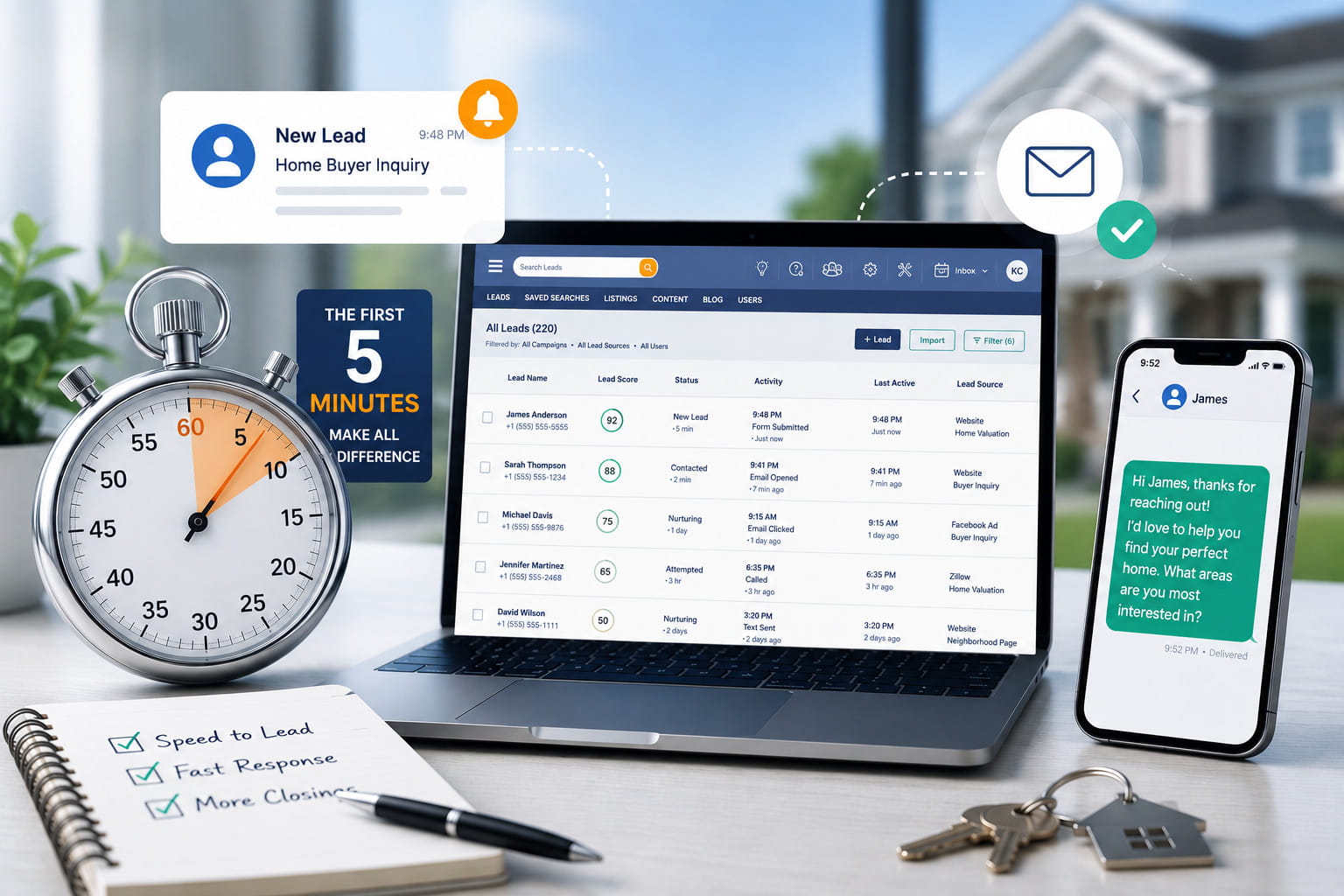
It’s 9:48 PM. A buyer who’s been browsing homes on your website fills out a form and hits submit. You see it at 8:30 the next morning — and by then they’ve already heard back from two other agents and started a conversation with one of them. You didn’t lose that lead because you were a worse agent. You lost it because someone answered faster. That, in one sentence, is why speed to lead is the most underrated lever in your entire business.
Quick answer: Speed to lead is how fast you respond to a new lead after they reach out. It matters enormously: research on online sales leads has found that responding within five minutes rather than thirty can make you roughly 21 times more likely to qualify a lead. Online buyers contact multiple agents and tend to work with whoever responds first, so the first few minutes often decide who gets the client.
What “speed to lead” means
Speed to lead — also called lead response time — is simply the elapsed time between a lead reaching out (submitting a form, requesting info, calling) and your first meaningful response. It sounds mundane. It’s anything but. Of all the metrics you could track, lead response time is the one most tightly linked to whether a lead ever becomes a conversation, because it operates in the narrow window when a buyer’s intent is at its absolute peak.
The research: why five minutes
The five-minute threshold isn’t a marketing slogan — it shows up consistently across the major studies of online lead response.
The most cited is the Lead Response Management Study, conducted by Dr. James Oldroyd at MIT in partnership with InsideSales.com, which analyzed more than 15,000 leads and 100,000 call attempts. Its headline finding: contacting a lead within five minutes rather than thirty makes you about 100 times more likely to make contact and 21 times more likely to qualify that lead.
A separate Harvard Business Review audit of 2,241 U.S. companies found that firms responding within an hour were roughly seven times more likely to qualify a lead than those who waited just an hour longer — and 60 times more likely than those who waited a full day. The same audit found the average company took around 42 hours to respond, and a large share never responded at all.
The throughline is simple: the odds of connecting and qualifying don’t decline gently — they fall off a cliff in the first half hour. (These are cross-industry findings, but the dynamic applies squarely to real estate, where online buyers behave exactly the way these studies describe.)
Why it hits even harder in real estate
A few things make speed to lead especially decisive for agents. Online buyers rarely contact just one agent — they fill out forms on several sites at once and start a conversation with whoever replies first, often regardless of who’s the better fit. Real estate is also a high-value transaction, so a single lead you respond to in time can be worth a year’s worth of small wins elsewhere. And buyer intent in real estate spikes hard in the moment: someone who just found their potential dream home is emotionally engaged right now, not tomorrow morning. Respond while that feeling is hot and you’re part of the story; respond the next day and you’re an afterthought.
The flip side is opportunity. Because the average response time is so slow, simply being fast puts you ahead of most of the competition. Speed to lead is one of the rare advantages available to any agent, at any budget — you don’t have to outspend anyone to out-respond them.
Why most agents miss the window (it’s a systems problem)
Here’s the uncomfortable part: knowing the five-minute rule and hitting it are completely different things. Agents miss the window not because they don’t care, but because of the structure of the job. You’re showing a property, in a closing, driving, or asleep when that 9:48 PM lead comes in. No one is sitting at a desk waiting to pounce on new leads, and after-hours inquiries pile up until morning. Working harder doesn’t fix this — you can’t be awake and available 24/7. It’s a systems problem, and it has a systems solution.
How to win on speed
You don’t hit a five-minute response time through willpower. You build a system that does it automatically — which is really what a real estate CRM is for:
- Instant automated first response. The moment a lead registers, an automated text and email goes out acknowledging them and starting the conversation — even at midnight. This single automation captures the critical window when you physically can’t.
- Instant lead routing. New leads are assigned to the right agent the second they arrive, so there’s no lag between capture and ownership. (Setting this up is covered in how to set up your CRM for conversion.)
- Mobile alerts and access. Real-time notifications and a real mobile app let you make personal contact fast from wherever you are, not just from your desk.
- Templates ready to go. Pre-written, easy-to-personalize messages remove the “what do I even say?” delay so a fast human follow-up is frictionless.
The instant auto-response is the foundation, and it’s a CRM automation capability — part of the broader follow-up engine covered in real estate CRM automation. Speed to lead is really the first and most important automation you’ll build.
Speed buys time — it doesn’t replace the conversation
One caution: fast doesn’t mean robotic. The goal of an instant response isn’t to close the deal in sixty seconds — it’s to hold the door open until you can have a real conversation. An automated “thanks, I saw you were looking at homes in [area] — happy to help; can I send a few more?” stops the lead from drifting to a competitor and buys you time to follow up personally. Speed gets you into the conversation; it doesn’t substitute for it. The best systems respond instantly and automatically, then hand off seamlessly to a human the moment the lead engages.
Frequently asked questions
What is speed to lead?
Speed to lead (or lead response time) is how quickly you respond to a new lead after they reach out. It’s measured from the moment they submit a form, call, or inquire to your first meaningful response — and it’s one of the strongest predictors of whether a lead converts.
What’s a good lead response time in real estate?
Under five minutes for the first touch. Research on online leads shows the odds of qualifying drop sharply after that window, and since the average business takes many hours to respond, being fast puts you well ahead of most competitors.
Why does responding within five minutes matter so much?
Because buyer intent peaks the moment someone reaches out, and online buyers typically contact several agents at once. Studies have found that responding within five minutes rather than thirty makes you roughly 21 times more likely to qualify a lead — the first responder usually wins.
How can I respond to leads faster?
Automate the first response. An instant automated text and email, paired with immediate lead routing and mobile alerts, lets you hit the five-minute window even when you’re showing a home or asleep — then you follow up personally once the lead engages.
Make speed your advantage
Speed to lead is the cheapest, highest-impact improvement most agents can make — and it’s almost entirely a matter of having the right system in place. To see how instant response fits alongside automation, nurturing, and the rest of a CRM that converts, read our complete guide to real estate CRM.