Real Estate SEO on Sierra Interactive: What Actually Works
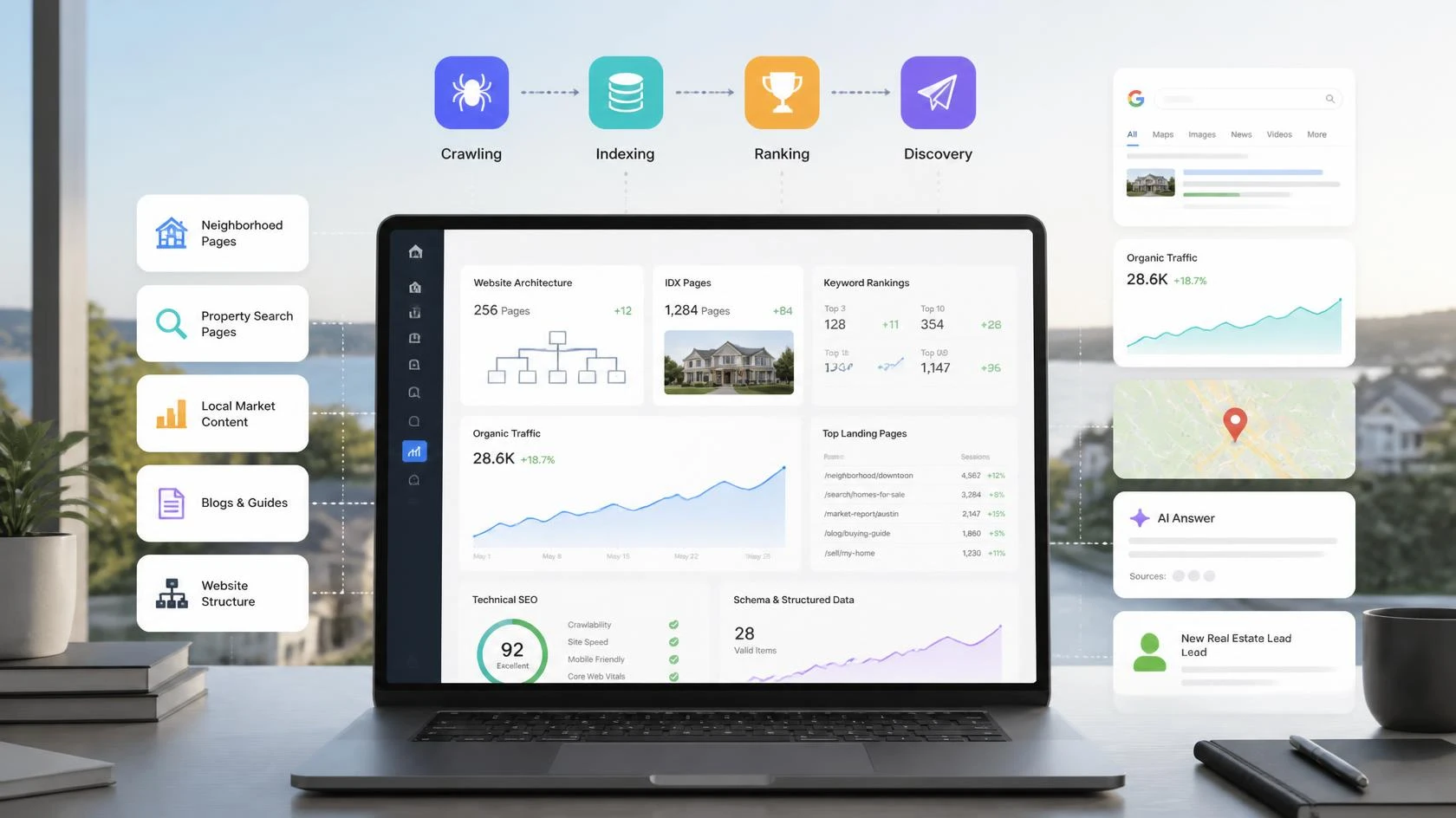
Effective real estate SEO on Sierra Interactive requires strategic website architecture, precise IDX configuration, intentional keyword usage, and a disciplined content strategy. Prioritizing quality over quantity—in both IDX pages and content—is what separates high-performing real estate websites from those that stall.
Most real estate agents take the same approach to SEO: add more pages, publish more blogs, and wait for traffic to come. After 16 years in real estate SEO, the evidence points clearly in the other direction. More is rarely better. Strategy is what drives results.
Sierra Interactive gives agents, teams, and brokerages a powerful platform to build a high-performing real estate website. But the platform is only as effective as the strategy behind it. Getting the most from Sierra Interactive means making deliberate decisions about which IDX pages to create, how to structure your website, which keywords belong where, and how to pace your content publishing.
Why Website Architecture Matters More Than Page Volume for Real Estate SEO
There was a time—and many experienced SEOs will remember this—when the standard approach to real estate SEO meant creating a landing page for every single search category in your MLS. With Sierra Interactive’s IntelliSearch now integrated into the platform, it can be tempting to go back to that method, spinning up pages for every property type, feature, and style imaginable. Years ago, that approach had its merits. But both search competition and search engine algorithms have evolved significantly since then, and what once worked can now actively hurt your performance.
The goal of website architecture today is not comprehensiveness for its own sake—it’s prioritization. Not every property type, home feature, or home style drives meaningful search traffic. Knowing which ones do, and building your site deliberately around those, is what allows Sierra Interactive’s IDX capabilities to work in your favor rather than against you.
Which IDX pages should you actually prioritize?
Certain search categories are essential even when they’re highly competitive. Broad, high-volume searches—like “homes for sale in [city]” or “condos for sale in [neighborhood]”—may take time to rank, especially on newer websites. But they still need to exist because they establish the structural foundation of your site and signal to search engines that you operate a comprehensive, authoritative resource.
The key is distinguishing between pages built for long-term authority and those that can drive traffic in the near term. For a newer Sierra Interactive website, prioritizing lower-competition, highly specific IDX pages—particular neighborhoods, niche property types, or home features with strong local demand—creates early ranking and lead generating opportunities while broader pages build authority over time. At this point, targeting niche search categories for organic lead generation is widely understood—most real estate professionals with any SEO experience are already doing it. The more critical, and often overlooked, question is how to optimize these pages in a way that supports sitewide growth and overall SEO performance, which is where many fall short.
Why too many IDX pages can damage your SEO performance
Every time Google crawls your site, it allocates a limited budget to that crawl. If your Sierra Interactive website contains hundreds or thousands of IDX pages targeting searches that receive little to no traffic—even if some of those pages rank—you’re diluting that crawl budget and signaling to search engines that a large portion of your content provides minimal value.
The standard is straightforward: if an IDX page isn’t likely to drive traffic, and it doesn’t serve a clear structural purpose, it shouldn’t exist on your site. Overloading a website with thin or redundant IDX pages undermines the pages that actually matter. Generating pages for every price range, bedroom count, bathroom count, and inconsequential property feature will ultimately work against your SEO efforts.
How Language and Keyword Precision Shape Real Estate SEO Results
Understanding which transactional keywords to use is one thing. Knowing where to place them—particularly in filename and URL structure—is another level of precision that separates effective real estate SEO from guesswork.
Another critical consideration is that language isn’t uniform across real estate markets, and subtle differences in terminology can translate directly into lead volume. In some markets, buyers search for a “casita.” In others, the same space is called a “guest house.” From an SEO perspective, these terms serve the same purpose, and having two separate pages competing in search results is counterproductive. The more effective approach is a single, well-structured page optimized primarily for the term most commonly used in your market, while naturally incorporating the secondary term throughout the content to capture any traffic searching for the less common variation.
While this may seem obvious, market-specific language is overlooked far too often — particularly by SEO vendors who consistently fail to deliver optimal results for their clients. A handful of additional leads per month—leads that come specifically from ranking for the right local term—adds up to significant revenue over a year. Attention to local dialect is what creates that opportunity.
The real cost of auto-generating IDX pages without review
Allowing a vendor or tool to auto-generate hundreds of IDX pages at once, without reviewing how each page is optimized, is one of the most damaging mistakes a real estate website owner can make. There is little to no evidence that this approach produces long-term, sustainable results in highly competitive markets. But also consider what happened with Matt Myatt, a top producer in the Outer Banks, before connecting with me for professional SEO support. A third-party vendor had auto-generated hundreds of poorly-crafted IDX pages for his site. In his MLS, “Gated” was listed as a community feature—alongside amenities like community pools and clubhouses. The result was that his gated community pages were automatically optimized for “homes with a gated community,” not “gated community homes” or “gated homes for sale.” It’s an absurd outcome, but it’s the kind of mistake that happens constantly when IDX pages are generated in bulk without individualized review.
Every search category and IDX landing page on a Sierra Interactive website should be intentionally and uniquely optimized. That applies to the page title, the meta description, the H1, the filename, and even the keyword-rich content. There are no shortcuts here that don’t eventually cost you.
Content Strategy: Why Volume Is the Wrong Metric
Publishing more blog content is one of the most persistent myths in real estate SEO. The belief that 30, 40, or 50 blog posts per month demonstrates SEO commitment is not only wrong—it’s a liability.
With the emergence of AI, I’m even seeing some website owners publishing 90 or more posts in a single month. That level of content volume is a signal of inexperience, not effort. Sites that produce this kind of content glut often see a short-term traffic spike followed by stagnation, ranking drops, or Google quality penalties. The spike is misleading. The long-term consequences are not.
What content should you actually publish?
The common approach—visiting successful competitor real estate websites and replicating their blog topics—produces predictable outcomes. You’re attempting to outrank established domains on topics where they already have authority, age, and backlinks. For most real estate websites, that’s a slow road to a pile of non-performing content.
The better approach is identifying topics your competitors haven’t covered, or haven’t covered well, that your target audience is actively searching for. Publishing content that ranks and drives traffic immediately strengthens your domain authority. That earned authority then creates the runway to target more competitive topics over time. It’s a compounding model, not a sprint.
The 80% traffic benchmark every real estate blog should hit
For client websites working with me, the target is clear: at least 80% of all published blog posts should drive consistent organic traffic every single month. Not occasionally. Not during peak buying season. Every month.
This benchmark exists because Google treats content performance as a quality signal. A website where the majority of published articles generate no traffic tells the algorithm that the site is not a reliable resource. A website where 80% or more of articles drive consistent traffic sends the opposite message—and that signal can lift rankings across the entire domain, not just for individual posts.
This is precisely why volume control is critical. For most agent, team, or brokerage websites, publishing more than 10 blog posts per month will create more problems than it solves over time. Established, high-authority websites with a strong track record of consistent organic performance can certainly support a higher volume of content. However, it is important to wait until your site has genuinely reached that level of authority and traffic before scaling up output. Publishing at higher volumes too early can undermine domain-wide rankings rather than strengthen them. And even for high-authority sites, increasing content volume should always be accompanied by rigorous, ongoing performance reviews to ensure each post is contributing meaningfully to overall site health.
How many blog posts should a newer website publish per month?
For newer Sierra Interactive websites, the right number is typically three to five carefully chosen posts per month. Each post should be selected based on traffic potential and competitive viability, published with proper on-page optimization, and monitored for performance before the next round of content is scaled.
This pace feels slow to most agents. It isn’t. A site with 24 posts where 22 drive monthly traffic outperforms a site with 200 posts where 30 do—in authority, in crawl efficiency, and often in lead generation. Publishing at a lower volume also makes it far easier to evaluate performance with clarity. When you’re managing a modest content library, you can identify what’s working, what isn’t, and take decisive action—whether that means refining underperforming posts, adjusting your keyword targeting, or removing content that is diluting your site’s authority. That level of oversight becomes nearly impossible when you’re managing hundreds of posts simultaneously. Building from a foundation of performing content is what creates sustainable SEO momentum on Sierra Interactive.
Strategic Approach to Landing Page Content
Just as with blogging, landing page content requires a thoughtful, strategic approach to deliver meaningful SEO results. The common misconception that “more is better” often leads to rushed, high-volume production of landing page content, frequently using AI-generated text. This approach not only fails to resonate with users but can also damage a brand’s credibility and SEO performance. In fact, one of my most time-consuming tasks lately has been addressing this very issue—cleaning up extensive amounts of poorly crafted landing page content that ultimately hinder search rankings and user experience.
Effective landing page strategy involves understanding what to include and, importantly, what to leave out. Overloading pages with keyword-dense material or irrelevant information detracts from their utility and can dilute their focus. Equally important is developing a deliberate approach to internal linking. Building an internal linking structure that aligns with pillar content and spreads authority strategically is far preferable to indiscriminately adding links without regard for site structure or organization. Taking the time to define clear objectives and ensuring landing pages serve both users and search engines will always outperform widespread, hastily created content using your AI tool of choice.
Real-Life Results
The true measure of any SEO strategy is the results it produces. The websites highlighted below have achieved their success by implementing the exact strategies outlined here — effectively utilizing Sierra Interactive’s tools in the way they were designed to be used. It is worth noting that our SEO efforts for these websites extend beyond what is covered here, but their results are a direct reflection of these core principles in action.
- After dedicating significant time to building a solid foundation and optimizing existing pages, Atchley Realty reached the 100 new organic leads per month milestone in July, just one year into more advanced SEO efforts.
- Kris Lindahl is one of the most recognizable names in real estate, and his website already carried considerable authority when I began working with him. With an aggressive budget and the right strategy, we grew his organic traffic from 9,000 to over 60,000 users per month in under two years.
- Over the past several years, Jeremy Olsher has been steadily investing in SEO since transitioning to Sierra Interactive. During this time, we’ve generated more than 3,600 organic leads—a testament to consistent effort and strategic content planning.
- Nick Nastos, one of my longest-standing clients, exemplifies the value of consistency and adaptability in SEO. Over more than a decade, we’ve navigated fluctuating market conditions together. During peak periods like 2015 and 2016, his website reached approximately 1,500 new organic leads per month. Even amid today’s challenging real estate and search landscape, his site consistently delivers 450 to 600 organic leads monthly. In 2016, his cost per organic lead was under $2, with higher quality leads compared to many paid sources. Today, despite shifting conditions, his organic cost per lead remains under $6 — well below most high-performing PPC campaigns.
- Effective SEO can also deliver strong results in smaller markets. Tim Moldenhauer, based in Northwest Arkansas, recognized the value of SEO after gradually building out his website. After increasing his investment level in October 2025, his website is already generating around 60 organic leads per month in under a year.
- Calgary is one of the most competitive real estate SEO markets, yet John Mayberry’s website continues to generate over 200 organic leads per month. As a long-standing client, we are also managing the recent transition to Sierra Interactive and ongoing SEO efforts for his brokerage’s website, CIR Realty. Our long-term goal is to position CIR as one of the highest-traffic real estate websites in Alberta and British Columbia.
- Greg Dallaire, widely known as “Green Bay Greg,” also had a website with strong domain authority when we began working together, which provided a solid foundation for driving results. Work on his website began in the fall of 2024, during which the site recorded 64,000 new organic users. Following a full year of content strategy and significant technical improvements, organic traffic climbed to 102,000 new organic users in 2025 — an increase of 38,000 users year-over-year.
While these examples illustrate the potential of an effective SEO strategy, results cannot be guaranteed. SEO performance and timelines depend on a wide range of factors, including market conditions, budget, competitor activity, existing website authority, domain age, and other external variables.