2026 Real Estate Technology Trends to Watch

The defining real estate technology trend of 2026 is simple to state and hard to overstate: AI has moved from novelty to infrastructure. The tools that were experiments two years ago (e.g., AI assistants, generative content, predictive analytics) are now the baseline that top-producing agents run on every day. The agents pulling ahead aren’t the ones with the most gadgets. They’re the ones who let technology handle the repetitive work, allowing them to focus on relationships and negotiation.
Here are 14 trends shaping how agents generate, convert and serve clients this year and what each one means for your business.
1. AI assistants take over the first touch
The biggest shift is who (or what) answers a lead first. Conversational AI, such as chat and voice assistants that operate 24/7, now handles the initial response to inquiries, answering listing questions, qualifying buyers and booking appointments before a human agent ever picks up. Because speed-to-lead is the single strongest predictor of conversion, an assistant that replies in seconds rather than hours captures leads that used to go cold.
What it means for you: The goal isn’t to replace the agent, it’s to make sure no lead waits. Let AI cover the instant first response and routine questions, then step in as the human when the conversation gets real.
2. Generative AI becomes the content engine
Writing listing descriptions, drafting marketing copy, staging empty rooms virtually and producing social content used to eat hours. In 2026, generative AI writes the first draft of most of it in seconds. Zillow’s leadership has gone as far as calling generative AI potentially more transformative for the company than the shift to mobile was. A sign of how seriously the industry’s largest players are treating it.
What it means for you: Use AI to produce the first version and your expertise to make it accurate and on-brand. The agents who win here treat AI as a drafting partner, not an autopilot. Every listing description still needs a human who knows the property.
3. Getting found shifts from SEO to AEO
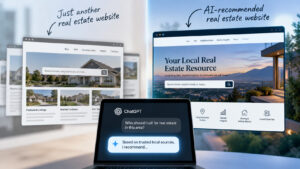
How buyers and sellers discover agents is changing. More searches now end inside an AI answer (e.g., Google’s AI Overviews, ChatGPT, Perplexity) rather than a list of blue links. That means the new visibility game is answer engine optimization (AEO): structuring your content so AI engines quote and cite you as the answer with clear answers, clean schema and content written the way people actually ask questions.
What it means for you: Ranking on page one is no longer enough if the click never happens. Optimize to be the cited answer, not just a result.
4. Predictive analytics tells you who to call first
Data is getting smarter about timing. Predictive models now score your database for propensity to sell or buy, flagging which past clients and leads are most likely to transact in the next few months based on behavioral and market signals. Instead of working a list top to bottom, agents work it in order of likelihood.
What it means for you: Your existing database is probably your most undervalued asset. Predictive lead scoring turns it from a static contact list into a prioritized call sheet, so your time goes to the conversations most likely to close.
5. AI-driven advertising and smarter ad spend
Paid lead generation is getting more efficient as AI takes over budget allocation. Platforms now shift ad spend automatically toward the audiences, creatives and times of day that convert, and use AI to build and refine targeting that used to require a specialist. For agents running Google and Meta campaigns, that means less guesswork and, often, a lower cost per lead.
What it means for you: You no longer need to be a PPC expert to run profitable campaigns, but you do need to track cost per lead and return, not just clicks. Let the system optimize the spend, and judge it on leads and closings.
6. The patchwork tech stack gives way to consolidation
For years, agents stitched together a website from one vendor, a CRM from another, ad management from a third and a dialer from a fourth – tools that didn’t talk to each other and leaked leads in the gaps. The 2026 trend is consolidation: moving to platforms where the website, CRM, lead capture and marketing share the same data, so a lead’s behavior on your site instantly informs the follow-up. All-in-one platforms like Sierra Interactive, a real estate platform that combines a CRM, IDX websites and ad management for agents, teams and brokerages, are built on this principle, but the shift matters, whatever tools you choose.
What it means for you: Fewer tools that integrate beat more tools that don’t. When evaluating technology this year, weight how well it connects to the rest of your stack as heavily as any individual feature. The biggest losses come from leads falling through the cracks between disconnected systems.
7. CRM-integrated dialers and automated follow-up
The phone isn’t going anywhere, but how agents use it is changing. Power and multi-line dialers built into the CRM let agents work a call list without misdialing, log every outcome automatically and trigger the next follow-up the moment a call ends. Paired with automated text and email cadences, no lead waits and nothing slips through.
What it means for you: Manual dialing and manual note-taking are where prospecting time disappears. A dialer wired into your CRM turns an hour of calls into more conversations, and a clean record of every one.
8. Hyper-personalization from behavioral data
Generic email blasts are losing to messages triggered by what a contact actually does. When a lead saves a listing, revisits a neighborhood page, or opens three emails in a week, modern systems flag that intent and tailor the next touch to it. The result is outreach that feels timely instead of intrusive.
What it means for you: The data to personalize is already sitting in your website and CRM. Use behavioral triggers, such as saved searches, repeat visits and listing views, to decide who to contact and what to say, rather than sending everyone the same thing.
9. Immersive tours and virtual staging become the default
Interactive 3D tours, AI-generated virtual staging and video walkthroughs have moved from “nice to have” to buyer expectation. Buyers increasingly pre-screen homes online and only tour in person once they’re seriously interested, which means listings without immersive media quietly lose attention to those that have it. AI virtual staging, in particular, lets agents furnish empty rooms digitally at a fraction of the old cost.
What it means for you: Immersive media isn’t just marketing polish. It pre-qualifies buyers and reduces wasted showings. For listing presentations, it’s also a tangible differentiator sellers can see.
10. Automated CMAs and AI listing presentations
Building a comparative market analysis and a polished listing presentation used to take hours of manual work. AI now assembles comps, drafts the narrative and produces a branded presentation in minutes, which the agent then refines with local judgment. The speed lets you walk into a listing appointment fully prepared on short notice.
What it means for you: Faster, sharper presentations win more listings. Especially when you can turn one around the same day. Let AI do the assembly while you supply the pricing strategy and local context that actually persuade the seller.
11. Branded mobile apps deepen client relationships
More agents and teams are putting a branded home-search app in clients’ hands. An app keeps your listings (and your name) on the buyer’s phone, sends push notifications the moment a matching home hits the market and creates a direct channel that email and portals don’t. For staying top-of-mind through a months-long search, it’s hard to beat.
What it means for you: An app isn’t right for everyone, but if you serve active buyers over long search windows, a branded app can be the difference between being their agent and being one of several they emailed once.
12. Transaction and document automation
The back half of the deal is getting automated too. Intelligent document tools now handle e-signatures, extract and check data from contracts and disclosures and flag missing items before they become problems. That cuts the administrative drag between accepted offer and closing.
What it means for you: Time saved on paperwork is time returned to clients and new business. Look for tools that integrate with how you already manage transactions, so automation removes steps rather than adding another login.
13. Data privacy and compliance move to the front
As agents collect more data and lean on more AI, privacy and compliance become a competitive necessity rather than an afterthought. Clients increasingly expect their information to be handled responsibly, and the rules around calling, texting and data use continue to evolve. Tools that build in consent tracking, secure storage and compliant communication are becoming standard rather than optional.
What it means for you: Treat privacy as part of the client experience. Use tools that keep your outreach and data handling compliant, and confirm the current calling and data regulations with your broker or counsel before launching any campaign.
14. Smart-home data and cost-to-operate transparency
On the property side, connected-home technology is changing what buyers want to know. Increasingly, buyers care not just what a home costs to buy but what it costs to run (energy use, smart systems and efficiency). Listings that surface this data stand out, and the information is becoming easier to capture and present.
What it means for you: When a listing has IoT-connected or energy-efficient systems, feature them explicitly in your descriptions and tours. It’s the information that today’s buyers actively look for.
How to actually use these trends in 2026
Don’t chase all 14 at once. Pick the one that fixes your biggest current leak. If leads go cold before you reach them, start with AI first-touch, dialers and speed-to-lead (trends 1, 7). If you generate traffic but few leads, look at your website, AEO and immersive media (3, 9). If your pipeline is full but disorganized, predictive scoring, personalization and a consolidated platform will do the most (4, 6, 8). The through-line for every trend on this list is the same: let technology handle volume and speed so your human judgment goes where it actually matters.
Frequently asked questions
What is the biggest real estate technology trend in 2026? AI is moving from experiment to everyday infrastructure. Specifically, AI assistants handling first-touch lead response, generative AI producing marketing content and predictive analytics prioritizing which leads to contact. Most other trends this year are downstream of AI maturing into core tooling.
Will AI replace real estate agents? No. The consistent pattern in 2026 is AI amplifying agents, not replacing them. AI handles repetitive, high-volume tasks (instant responses, drafting content, scoring leads) so agents can focus on relationships, negotiation and judgment, which remain human work.
What is AEO and why does it matter for real estate? AEO is answer engine optimization. It’s structuring content so AI search tools (like AI Overviews, ChatGPT and Perplexity) cite you as the answer. It matters because more searches now end inside an AI-generated answer instead of a list of links, so being the cited source increasingly beats simply ranking.
What real estate technology should a new agent invest in first? Start with the system that captures and follows up on leads fast – a CRM (ideally one connected to your website) with automated speed-to-lead follow-up. Generating leads matters little if they go cold before you respond, so fix the response and follow-up loop before adding more tools.
Author

Related Posts


Real Estate CRM
Best Real Estate CRMs in 2026: An Honest...

Real Estate Business Planning