Mastering Real Estate Search with IntelliSearch: Part 1

The AI Search Revolution: Rethinking Real Estate Content Strategy in the Era of AI Overviews
By Cindy Liang, Sierra Interactive Sr. Product Manager
Introduction
Welcome to our three-part series on IntelliSearch, Sierra Interactive’s latest innovation in real estate search. In this series, we explore how AI is reshaping home search, how real estate professionals can leverage AI-powered content strategies and the specific steps you can take to implement these strategies using IntelliSearch.
In Part 1, we dive into how AI Overviews are transforming search behavior and what this means for your content strategy. Stay tuned for Part 2, where we explore how to integrate AI and content strategy with IntelliSearch and Part 3, where we break down actionable steps for optimizing your real estate content strategy.
Executive Summary
Internet search is undergoing a seismic shift. Recent studies reveal that AI Overviews now appear in nearly half of all Google searches, commanding significant screen real estate across both desktop and mobile devices. This isn’t just another algorithmic update – it represents a fundamental transformation in how users discover and consume information online.
The implications for real estate content strategy can’t be overstated. Traditional SEO has focused on keyword optimization, metadata and backlink profiles, but success in the AI era demands a more sophisticated approach. Recent studies indicate that while about half of AI Overview citations come from top-ranking pages, AI systems are increasingly looking beyond traditional ranking signals to find the most relevant content for users. Websites achieving consistent citation in AI Overviews share a common thread: they’re delivering content that deeply resonates with user intent.
Today’s AI algorithms are interpreting context, user behavior and the nuanced meaning behind queries. This demands an urgent shift in how real estate professionals approach content creation and optimization. While some searches trigger comprehensive AI Overviews, others notably don’t, particularly in the case of high-intent property searches. Understanding this distinction is crucial for real estate professionals looking to maintain and improve their online visibility in the era of AI-driven search.
The New Search Paradigm for Real Estate
The introduction of AI Overviews is changing how users consume information online. Traditional top-of-funnel searches like How-To topics and basic informational queries are now dominated by AI-generated overviews on search result pages. And AI Overviews don’t just aggregate information randomly. They strategically source content from:
- Top-ranking websites with established domain authority
- Authoritative sources demonstrating deep expertise in specific topics
- Content that directly addresses user queries, regardless of its ranking position
- Recent, up-to-date information that reflects current market conditions
As reported by Search Engine Journal [1], this shift is already impacting SEO significantly. It doesn’t signal the end of SEO as a core traffic channel, but it does indicate that real estate professionals will need to change their content strategy to fit an AI-first world. That means focusing on user intent.
Creating Quality Real Estate Content Through a User-Intent Focus
While we’ve long heard that quality content and E-E-A-T principles (Experience, Expertise, Authoritativeness, and Trustworthiness) are crucial for SEO, these guidelines can seem vague in the context of AI Overviews. Our research suggests a simple, clear and yet powerful measure: how well does your content answer the user’s intent?
It’s no longer enough to ensure your keywords show up in H1s and H2s. You have to focus on what users want. As Google’s John Mueller, who coordinates Google Search Relations efforts as a Search advocate, explains: “It’s time we evolve SEO to be full funnel. We gotta start thinking about user intent, what users want, do real marketing. It’s not enough to focus on clicks, and we’ve been spoiled. We’ve focused so much on tactics, right?”
For example, consider a search for “Benefits of owning an Eichler Home.” Eichler homes are mid-century modern homes built in California in the 50s and 60s by Joseph Eichler. They are generally a single story with open floor plans, lots of windows and minimal ornamentation. When someone searches for “Benefits of owning an Eichler home,” they may be mid-century architectural enthusiasts or they could be at a crossroads in their home-buying journey. Maybe they’re considering a mid-century modern home and encountered the term “Eichler.” Or perhaps they’re specifically looking for single-story homes in California and keep seeing Eichler references.
To capture this Eichler-related search traffic, traditional SEO might focus on keyword optimization with repetitive terms like “owning an Eichler” and “Eichler homes.” However, this approach misses the crucial element of user intent. What is the user really looking for t? What are the features of an Eichler that makes this type of home stand out? These questions bring us back to our initial insight: a person searching for Eichler home benefits is very likely at a “crossroads” in their home buying journey: deciding between a single story home or 2 stories.
Let’s see this in action by looking at a blog post by EichlerForSale.com – “Time to Move to a Single-Story Home?”. This blog post is cited by AI Overview and upon further analysis, it is clear that this article directly addresses the user intent behind the search.
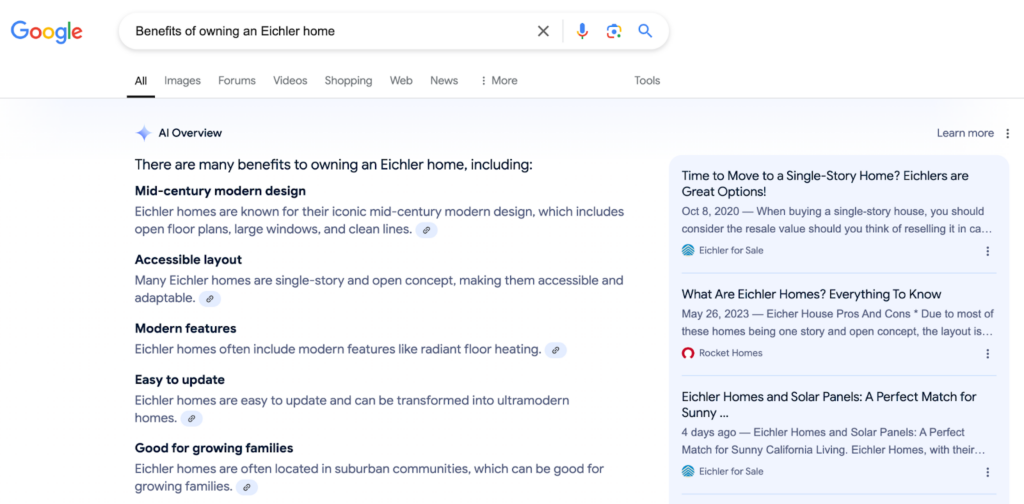
Instead of opening with architectural history or listing out well-known features, the article immediately addresses a common life transition: “Once the kids have left the nest, you may be wondering what to do with all of the extra space in your home.”
This immediate connection to a real-life situation demonstrates an understanding that while some searchers might be drawn to Eichler’s mid-century modern aesthetic, many are simply looking for single-story homes in a market where it’s increasingly rare. As the article later points out, “less than 40% of newly constructed homes on the West Coast are single story,” making Eichler homes an attractive option for buyers prioritizing single-level living over architectural style.
This article shows a deeper understanding of user intent: people searching for Eichler homes aren’t just looking for mid-century design; they’re often seeking practical solutions to lifestyle changes, and that’s why they’re searching for “benefits of owning an Eichler.” These are prospective buyers who may have stumbled upon Eichlers while searching for single-story homes in California, and now they want to understand what makes these particular homes worth considering.
From here, the article builds credibility through specific, verifiable claims: “Nearly all of the 11,000+ single-family homes built by Joseph Eichler were single story.” This isn’t just a random data point; it’s letting the prospective homebuyer know that an Eichler is a single story home, and there were many built. The article then provides more authenticity with home buyer quotes: “Many Eichler buyers tell us one of the major reasons they sought out Eichlers is because they were ‘tired of walking up and down steps.'”
What also makes this content particularly effective is how it progresses from emotional to practical considerations. Rather than just listing features, it explains benefits through the lens of homeowner needs:
- Energy efficiency isn’t just about having a single heating/cooling unit – it’s about long-term cost savings
- Maintenance isn’t just about cleaning – it’s about ease of upkeep as owners age
- Accessibility isn’t just about being single-story – it’s about creating a home that works for all life stages
- Investment value isn’t just about market trends – it’s about the peace of mind that comes with strong resale potential
Each feature is explained through the lens of real user needs rather than architectural features. For instance, instead of simply stating “Eichlers have radiant heating,” the article explains how this translates to better energy efficiency and lower costs, addressing the underlying concern about long-term homeownership costs.
This approach succeeds because it provides necessary context about Eichler homes without turning the article into a history lesson, and it supports claims with specific data and authentic user testimonials. The article also progresses logically from emotional to practical considerations and anticipates and answers natural follow-up questions through related and linked content at the bottom.
This article exemplifies how content that prioritizes user needs over keyword density naturally earns AI citation. It’s comprehensive without being overwhelming, specific without being restrictive, and most importantly, it directly addresses the underlying concerns that drive the search query.
A New Reality for Real Estate Search: The AI Overview Trigger Pattern
While AI-focused search affects all industries, it creates a particularly fascinating dynamic in real estate search. Our analysis reveals an AI Overview Trigger Pattern in how AI Overviews interact with structured real estate data, creating both challenges and opportunities for the industry.
Consider these two similar searches:
- “multi-generational living homes for sale in Louisville, KY”
- “homes for sale in Louisville, KY under $2,000,000 for multi-generational living”
What’s fascinating is how Google’s treatment of these searches evolved. The first search had consistently triggered an AI Overview while the second didn’t. More recently though, neither search generates an AI Overview. This shift isn’t random; it reveals how Google’s AI adapts as search patterns and available content evolve.
Traditional MLS data excels at structured information like price ranges, bedroom counts and square footage. However, it struggles with emerging lifestyle-focused searches that aren’t yet standard in property databases. When Google detects gaps between natural language searches and structured listing data, it may temporarily fill these gaps with AI Overviews. But as more relevant content emerges and search patterns stabilize, Google often shifts toward prioritizing actual property listings over AI-generated explanations.
In other words, AI Overview emerges at the intersection of natural language and structured data – but only temporarily, until Google can confidently map lifestyle-focused searches to relevant property listings. As an example, Google likely observed users finding value in multi-family and duplex listings when searching for multi-generational homes, so it adapted its results accordingly and showed listings instead of an AI Overview. These constant updates and evolutions in when and where AI Overview appears create strategic opportunities for real estate professionals who understand how to bridge the gap between how people naturally search and how property data is structured.
Content Strategy: The Role of Content Clusters and Cross-Linking
This pattern in AI Overview behavior demands a sophisticated approach to content strategy and creates a strategic opportunity for agents who understand how to:
- Build comprehensive community pages targeting specific lifestyle searches
- Create content that bridges the gap between traditional MLS data and modern search behavior
- Connect informational content with property listings in meaningful ways
Recent studies show that while 52% of AI Overview citations come from top-ranking pages, the remaining 48% come from beyond the first page. This suggests that quality content can earn visibility in AI-powered search results regardless of traditional ranking position. In fact, SEO strategist Eli Schwartz makes a compelling argument: relevance and topical authority will become the new currency of search. That means rather than pursuing high-authority backlinks indiscriminately, successful content strategies will focus on building comprehensive topic clusters that demonstrate deep expertise in specific areas.
Consider how content clusters and cross-linking opportunities might be created to build topical authority on multi-generational housing that will serve both an AI Overview citation purpose initially as well as surface relevant listings as Google’s search results adapt:
- Informational content explaining multi-generational living benefits
- Property listings optimized with specific multi-generational features
- Community guides highlighting neighborhoods suitable for extended families
- Market analysis of multi-generational housing trends
By creating networks of related content that anticipate and answer home buyer and seller questions, agents can establish the kind of topical authority that both users and AI systems recognize and trust.
Conclusion
In the era of AI-driven search, creating effective real estate content requires a fundamental shift from traditional SEO tactics to a user-intent-focused approach. By understanding what users truly seek—beyond keywords and rankings—real estate professionals can craft content that resonates on a deeper level and stands out in AI Overviews. As demonstrated by successful examples like EichlerForSale.com, addressing real-life needs, providing credible information and connecting emotionally with your audience are key to maintaining visibility and relevance in this evolving digital landscape. Embracing this strategy will not only help you adapt to the AI search revolution but also position your brand as a trusted, valuable resource for homebuyers navigating their journey.
AI is transforming the way buyers search for homes, and real estate professionals who adapt to these changes will have a significant competitive advantage. But understanding the shift is just the first step—how can you actively leverage AI-driven search for better results?
In Part 2 of this series, we’ll explore how IntelliSearch helps agents break free from traditional MLS constraints and build content strategies that truly align with modern search behavior.
Author

Previous Post